Summarize this post with:
AI overviews tend to be very useful resources for users, but they are not always reliable sources of information.
From time to time, AI responses contain inaccurate data or facts that contradict reality. When this happens, the user may be facing an AI overview hallucination.
Understanding why AI overview hallucinations happen can help you grasp their possible consequences for your online reputation.
What is an AI overview hallucination?
An AI overview hallucination, by definition, consists of incorrect or misleading responses from a language model presented to users as if they were real information.
If a user doesn’t pay close enough attention to the content an AI gives them, they may take the inaccurate information as true and use it for different purposes.
AI overview hallucinations examples
Understanding what a hallucination is in an AI assistant tends to be easier with simple examples such as the following:
- False bibliographic citations.
- Incorrect explanations.
- Wrong historical facts.
- Invented figures.
- Incorrect names.
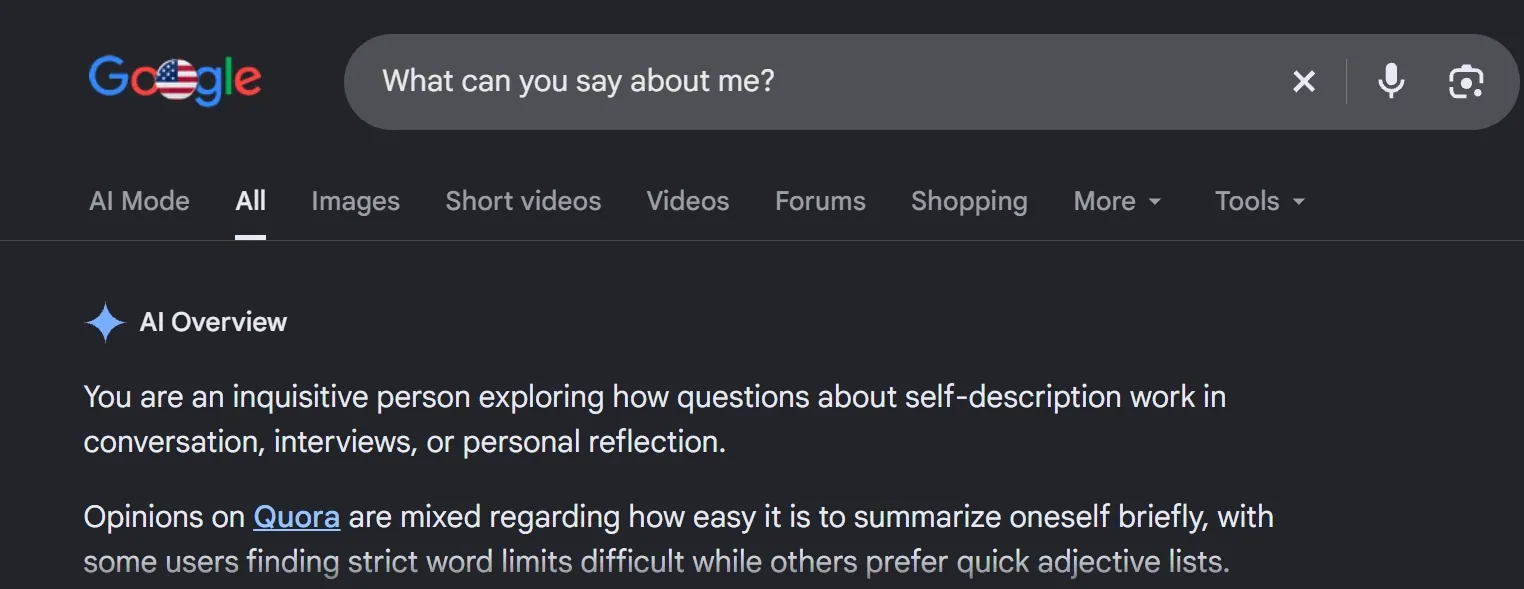
These AI hallucination examples generally go hand in hand with the model’s purpose of satisfying the user’s query in any way it can, even if that means creating information that doesn’t match reality.
Why do AI overview hallucinations happen?
AI overview hallucinations occur because AI models follow statistical patterns instead of real facts, which can lead to inaccurate results for the user.
We recommend reading the following points to better understand the origin of AI hallucinations:
- Statistical prediction to generate text: these systems don’t prioritize objective truth when generating information, but rather coherence and apparent fluency.
- Lack of factual understanding: AI doesn’t distinguish truth from falsehood, since it only imitates the structure of human language and has no access to our reality.
- Low quality training data: if the data used to train the language model was incomplete or ambiguous, the AI may invent information to fill the knowledge gap.
- Incomplete prompts: when the user submits an inaccurate query, the assistant may respond incorrectly to their question.
In general, an AI is not designed to admit the limits of its knowledge, so it tends to synthesize data and deliver information that seems coherent to it, even when it may have no real basis.
Is it possible to prevent an AI from hallucinating?
It’s possible to reduce how often AI hallucinations occur, but there will always be a chance the assistant produces a hallucination, since these systems don’t understand the world the way people do.
Also, because AI systems depend heavily on their training data, they are more likely to hallucinate when they receive queries about very recent topics or subjects that weren’t part of their training.

Take back control of your online reputation
We can review your case and offer a personalized solution to take back control of what’s said about you or your business online.
Get a quote in less than 24 hours
How to check if an AI is hallucinating
It’s possible to confirm an AI overview hallucination by comparing the response against reliable sources on the topic and checking whether the assistant’s information matches what those sources say.
Other useful ways to spot an AI hallucination can include:
- Repeating the query across different assistants: if one AI gives a response that’s very different from 2 or 3 other alternatives on the same query, that assistant is likely hallucinating.
- Checking the sources and links used in the response: it’s advisable to verify every author name, book, or website the AI cites to support its information, and to confirm whether the links lead to real websites.
- Evaluating the tone of the response: if an assistant uses an overly confident tone on uncommon or recent topics, the overview is likely the result of a hallucination.
- Looking for logical inconsistencies: to fill an information gap, an AI tends to invent data that contradicts earlier or later paragraphs.
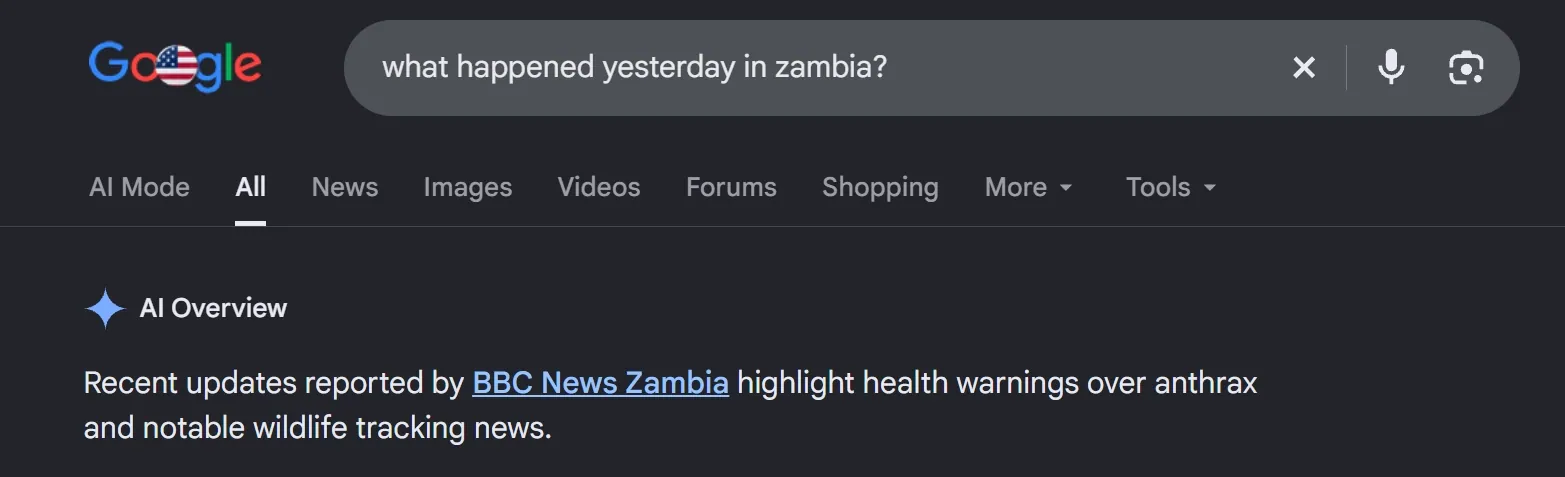
Developing critical thinking and cultivating reasonable doubt as a habit are two recommendations that tend to be useful for telling AI overviews with accurate information apart from those containing hallucinations.
What does an AI hallucination mean for my online reputation?
AI overview hallucinations can shift public perception of you or your business, since these overviews may share false or damaging information that harms people’s relationship with you.
That said, the consequences of an AI overview with inaccurate or invented information about your business can be summarized as follows:
- Impact on credibility: if the AI invents complaints about your products or claims your business is part of a fraud, your credibility within and outside your industry is likely to be compromised.
- Loss of new customers: potential customers who research your brand and use the inaccurate overview as a reference may end up ruling you out as an option.
- Fewer investment opportunities: investors tend to research a company online before proposing a partnership. If the overview presents damaging information, it may fail to build their trust.
- Less organic traffic to your website: if a user feels the AI response already answers their question, they may decide not to visit your website for more information.
Looking at these factors, we can say that an AI overview hallucination can be a significant reputational risk and a source of conflict that, within your means, it’s advisable not to leave unattended.
What should I do when an AI overview presents false information about me?
If you discover that an AI overview persistently gives false information about you, the most practical solution is to turn to an online reputation management and content removal specialist.
AI assistants tend to summarize information from multiple sources, and tracking those sources down and adjusting their content is likely to exceed the operational capacity and available time of a typical organization or public figure.
Related guide: Position zero: what it was and how AI answers replaced it
Need it handled for you? Our AI reputation management service corrects the sources behind what Google’s AI Overview says about your name or brand.
Final thoughts on AI overview hallucinations
AI overviews with inaccurate or contradictory data are a subtle, yet dangerous, source of misinformation.
For businesses and public figures, an AI overview hallucination can have repercussions for their reputation and also for their growth opportunities in the short, medium, and long term.
In this scenario, ongoing monitoring of AI overviews is advisable to help prevent potential reputational, financial, or business setbacks.
However, since AI overviews are still a relatively recent feature, many organizations may not know how to manage them. For these institutions, working with online reputation experts tends to be a good option.
At Media Removal we have experience optimizing the AI overviews shown by Google. We implement specialized solutions to align these overviews with the true identity of every institution and person who trusts us.
You can schedule a meeting with our team of experts so we can work together on a solution that shifts the content of the AI overviews you want to adjust in your favor.
 Subscribe to our newsletter
Reputation insights and industry news from the Media Removal team, straight to your inbox.
No spam. Unsubscribe anytime.