Summarize this post with:
Having the best tools for managing your reputation on the Internet does tend to make a difference for a company or a public figure.
If one tool is more useful than another for a specific purpose, it will likely deliver a better result and fulfill its purpose more effectively.
That said, let’s review which are the best reputation management tools and what each one is able to offer for the needs of organizations and individuals.
Google Alerts
Google Alerts is a free Google service dedicated to monitoring search engine results and notifying the user when the search engine indexes information that includes keywords of interest to a company or an individual.
This reputation management tool sends content summaries to the user’s email according to the frequency set in the alert configuration, which can be daily, weekly or even as soon as Google indexes new content.
Main features of Google Alerts
Although it is a free service, Google Alerts includes features that tend to be useful for people and institutions interested in monitoring what is being said about them in search results, such as:
- Keyword monitoring: this service allows users to track the names of people and organizations in Google results, as well as product names and exact phrases.
- Source selection: the user can choose which source to receive information from, whether blogs, news, videos, websites, or sources specializing in finance and books.
- Detection of emerging content: depending on the settings chosen by the user, this tool is able to send content just minutes after it has been indexed in the search engine.
- Information synthesis: the user has the option to choose whether to receive all results that include a certain keyword, or only the best matches.
This reputation management tool also offers the option to choose the geographic region from which alerts are to be received, as well as the language of the content to be monitored.
Ahrefs
Ahrefs is a search engine optimization platform that measures the organic traffic a person or company receives on their website.
Although it is not a tool designed primarily for reputation management, Ahrefs includes several features that tend to help uncover how users arrive at a web page on the Internet and the authority of that page on Google.
Notable features of Ahrefs
With the right strategic approach, Ahrefs can be a very powerful reputation management tool, and the following are some of the features capable of justifying that role:
- Detection of harmful links: this platform is able to identify spam links pointing to your domain with the aim of damaging its reputation in the eyes of Google.
- Brand search monitoring: this tool makes it possible to identify user searches related to you or your business, along with the level of traffic they drive to your website.
- Inbound link alerts: Ahrefs can send real-time alerts to the user every time their domain receives a new external link from a media outlet, a blog or any other website.
- Search ranking tracking: it is possible to monitor the evolution of an entire web domain or of specific pages in Google results to better assess their relationship with hypothetical changes in your reputation.
Finally, institutions and individuals who use Ahrefs will discover that the tool allows them to create custom reports based on the parameters and items of greatest interest to the user.

Take back control of your online reputation
We can review your case and offer a personalized solution to take back control of what’s said about you or your business online.
Get a quote in less than 24 hours
PEEC AI
PEEC AI is a platform that monitors a brand’s presence in the responses of artificial intelligence assistants and conversational search engines.
Through this reputation management tool, companies and public figures have the opportunity to understand what kind of information AI offers about them and whether their image changes from one assistant to another.
Key aspects of PEEC AI
PEEC AI’s focus on AI responses about a person or brand allows it to offer insights that are not usually common in conventional reputation management tools. Among this platform’s features, we highlight the following:
- Prompt tracking: PEEC AI makes it possible to track specific user queries to determine whether a brand or person appears in AI results.
- Multi-platform monitoring: it is possible to evaluate a keyword’s performance across ChatGPT, Gemini, Claude, Perplexity, Grok and other AI-based environments.
- Visibility measurement: PEEC AI users have the option to analyze their brand’s visibility in conversational search engines over time and compare it with that of their competitors.
- Source analysis: this tool includes the ability to detect which web pages and specific links are cited by an AI as an authoritative source on a given topic.
Another important PEEC AI feature for reputation management is its sentiment analysis, since this tool makes it possible to identify whether an AI’s responses about a brand tend to be positive, negative or neutral.
Trustpilot Business
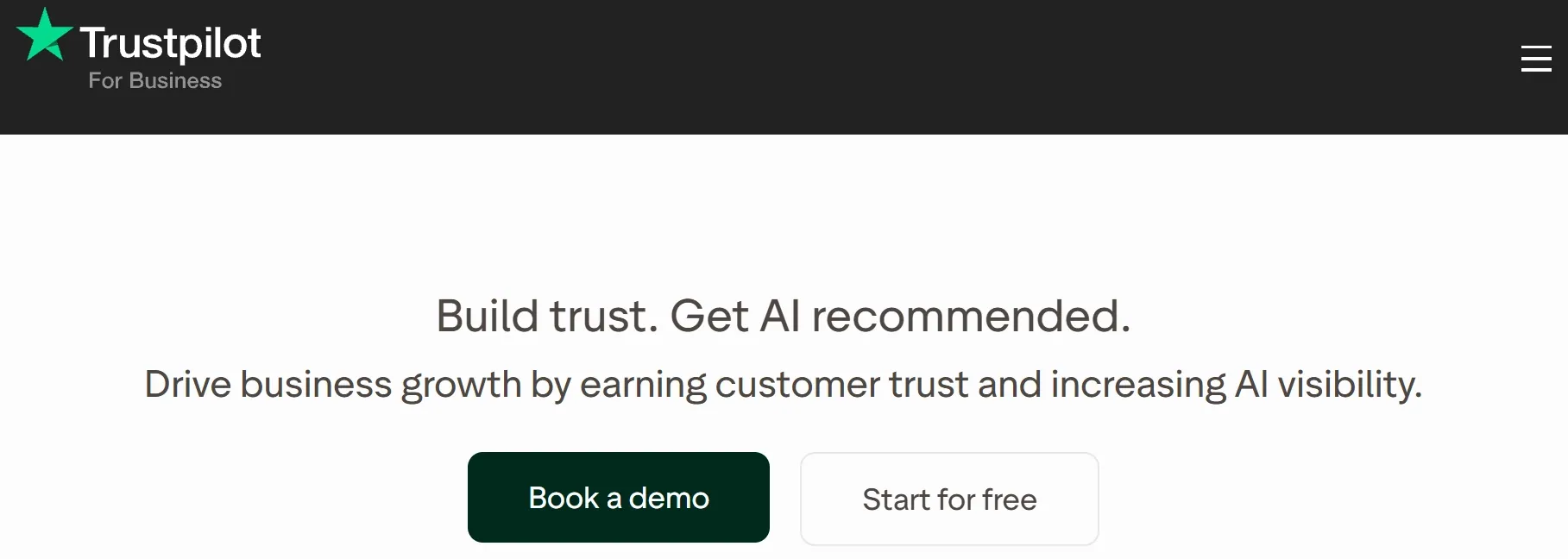
Trustpilot Business is Trustpilot’s official portal for companies that have claimed their profile on the directory and are interested in having a specialized suite to manage their reputation both on and off this platform.
As a reputation management tool, Trustpilot Business makes it possible to channel a company’s customer reviews to its profile on the directory and, at the same time, display its Trustscore on strategic pages and digital channels.
Main features of Trustpilot Business
Organizations that use Trustpilot Business generally get a service with multiple useful functions to boost their online reputation. Among those functions, we find:
- Automated review invitations: companies that use this tool have the option to send automated invitations to their customers to encourage them to write a review on Trustpilot.
- Website widgets: companies that use this platform have the opportunity to generate custom code and embed it on their website or online store to display their Trustpilot rating in real time.
- Competitor analysis: Trustpilot Business offers the option to compare one business on the directory with another to review the ratings and reviews of each.
- Fraud detection: this tool has systems trained to identify fake or malicious reviews designed to damage your reputation and Trustscore.
Lastly, this reputation management tool usually helps organizations gain access to Trustpilot’s customer support channels in order to receive specialized assistance.
The best reputation management tools side by side
Understanding what sets each of the above tools apart tends to be easier when they are compared using key criteria to assess their overall performance. That said, the following comparison table will likely be quite useful for this:
| Criteria | Google Alerts | Ahrefs | PEEC AI | Trustpilot Business |
|---|---|---|---|---|
| What does it do? | Searches for mentions of keywords, brands or names, and notifies you by email when they appear. | Monitors a brand’s visibility on Google and analyzes its inbound links and keywords. | Measures how often and with what sentiment a brand appears in AI engine responses. | Collects customer reviews and displays them on a public Trustpilot profile and strategic digital channels. |
| Strengths | Broad coverage of the web indexed by Google. Useful for early detection of mentions. | Industry-leading backlink index, with robust keyword and competitor data. | Specific focus on visibility in conversational search engines. Covers several language models at once. | Integration with the brand’s website and strategic digital channels. |
| Limitations | Does not cover social media or reviews in real time. Does not include a management dashboard. | The learning curve tends to be steep, and it is not a dedicated reputation management tool. | Does not cover traditional reviews or social media, and pricing will likely scale with the number of prompts tracked. | The free plan is very limited, and the cost of premium subscription tiers tends to rise annually. |
| When is it best used? | Basic, free brand monitoring. | When technical SEO needs to be combined with brand monitoring. | When the priority is understanding how you appear in generative AI. | When the goal is to build reputation with verified reviews. |
None of these platforms can be swapped for another, since each one covers a different angle of online reputation management and tends to make it easier to track certain elements of interest to companies or public figures.
Your reputation also deserves a good strategy

A reputation management tool can deliver good results on its own, but it will most likely unlock its full potential only when backed by a clear strategy.
When there is a strategic plan guiding the use of the platform, giving it clear objectives and indicators to measure its performance, the reputation of the person or organization using the service tends to benefit more.
That said, when it comes to defining a concrete and solid strategy for your image on the Internet, having the support of online reputation experts tends to be a favorable scenario.
At Media Removal we use the best tools to help companies and individuals strengthen and monitor their online reputation and gain greater control over their brand narrative on the Internet.
We invite you to schedule a meeting with us to tell us about your case and start developing a solution with real and lasting impact.
 Subscribe to our newsletter
Reputation insights and industry news from the Media Removal team, straight to your inbox.
No spam. Unsubscribe anytime.