Summarize this post with:
Many times, a company or public figure with a strong online image has a specialized online reputation management firm as an ally.
Agencies dedicated to internet reputation management tend to develop and launch different strategies to help their clients control the information that appears about them across various digital channels.
Understanding how online reputation management companies work can be useful for grasping an area that keeps growing in importance at the business level.
First stage: initial consultation with the client
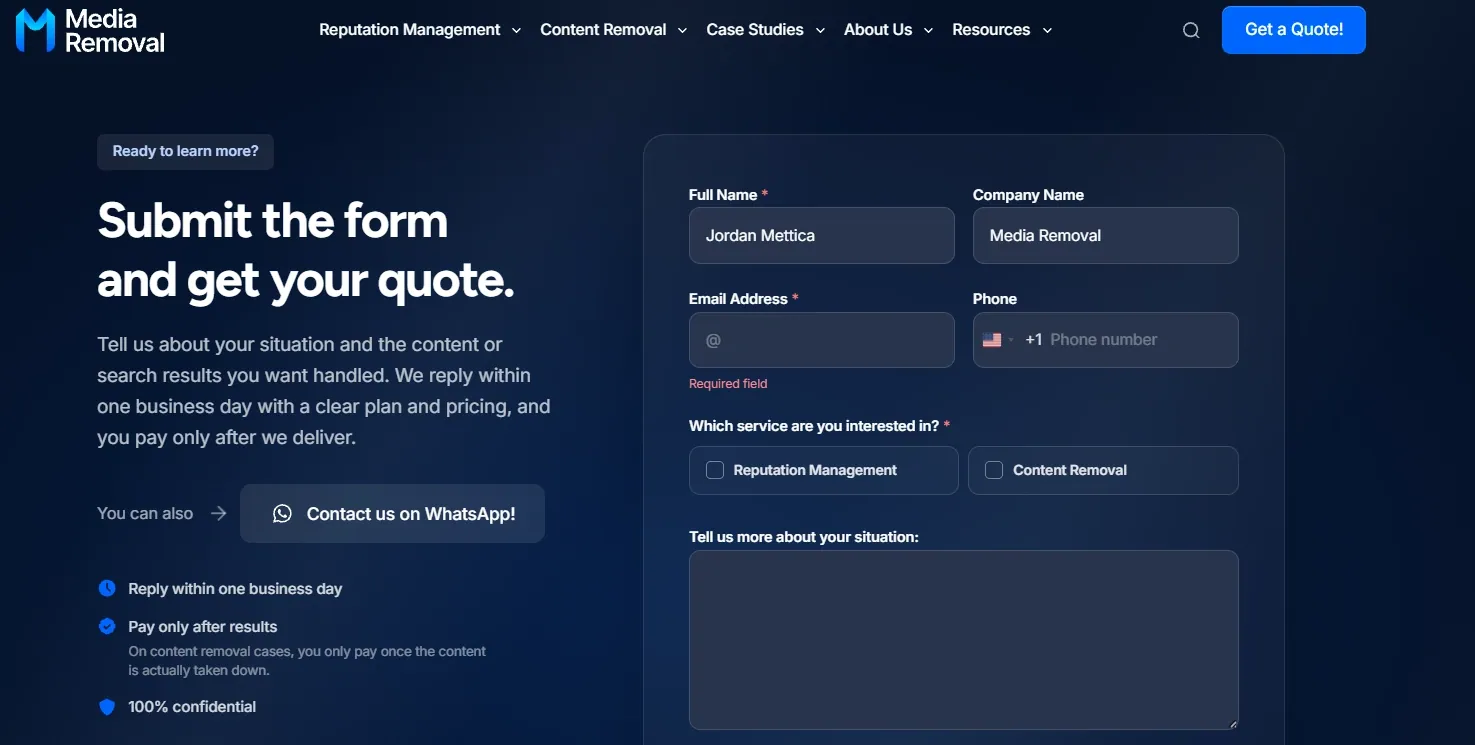
Generally, the workflow of an online reputation agency begins when a client schedules a meeting to present a problem or a need.
Some of the possible scenarios that institutions or individuals bring to this first consultation have to do with:
- There is content about them online that they want to remove.
- Their first page of Google results does not show what they want it to show.
- They want to start a public relations campaign to gain media coverage.
- They need support for the launch of a new product or service.
At this stage, the main task for online reputation agencies tends to be identifying the root cause of the client’s problem or situation in order to classify their pain point and, as a result, its likely solutions.
Second stage: preparing the work proposal
After finishing the first meeting with an institution or person, online reputation agencies begin preparing a work proposal.
Before or while the proposal is being built, the company may need to run a diagnostic audit of the client to pinpoint their actual needs with greater precision.
What information does an online reputation management company usually include in its work proposal?
The agency’s work proposal may include the scope of support over time, the methods to be used to resolve the person’s or institution’s need, and the estimated budget for carrying out the service.
Commonly, even when it is part of the overall strategy, content removal has a separate budget.
This document can span periods of 6, 12, or 18 months depending on the client’s needs and the solutions the online reputation company must carry out.

Take back control of your online reputation
We can review your case and offer a personalized solution to take back control of what’s said about you or your business online.
Get a quote in less than 24 hours
Third stage: evaluating the first page of results
When a client asks for support to improve their page 1 of Google results, one of the first points reputation companies tend to address is evaluating which solutions they can realistically execute.
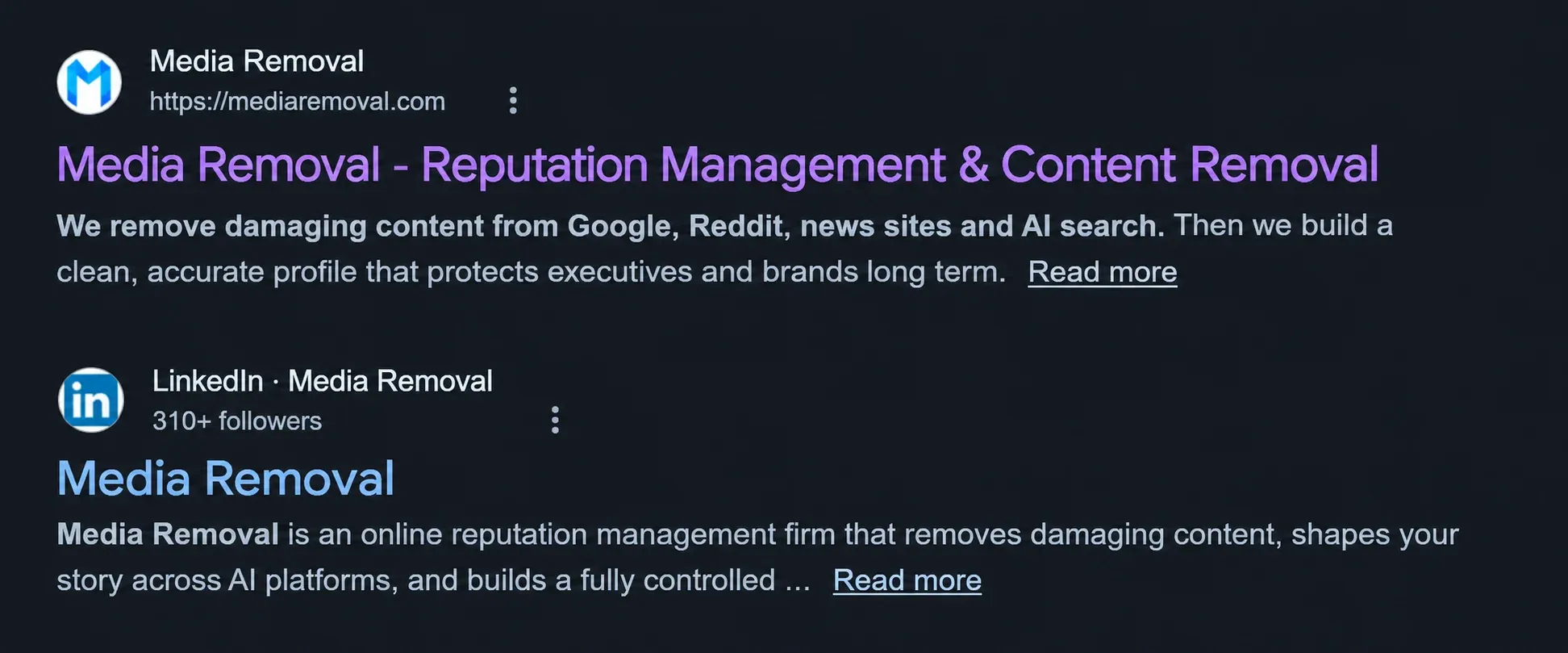
With this phase, these companies can better define whether the client will need information removal solutions, suppression of harmful links, creation of positive content, or a combination of these and other approaches.
The main goal for reputation companies when working on a client’s page 1
The main goal for a reputation company working on its client’s search results is helping Google understand what the business entity is, what the organization or public figure does, and its possible impact or relevance.
To do this, reputation agencies focus on reinforcing the business’s trust signals toward Google and consolidating its entity in front of the search engine. Some of the actions typically carried out for this purpose include:
- Creating or updating business profiles.
- Adding the business to new review directories.
- Removing duplicate domains.
- Suppressing links containing false or defamatory content.
As reputation companies carry out these actions, Google tends to receive more and better signals that allow it to build a real and favorable image of the client within the search engine, which tends to make ranking easier.
Fourth stage: auditing Google’s AI Overview
In parallel with reviewing and updating the client’s first page of results, online reputation companies also examine the content of the AI Overview the search engine produces.
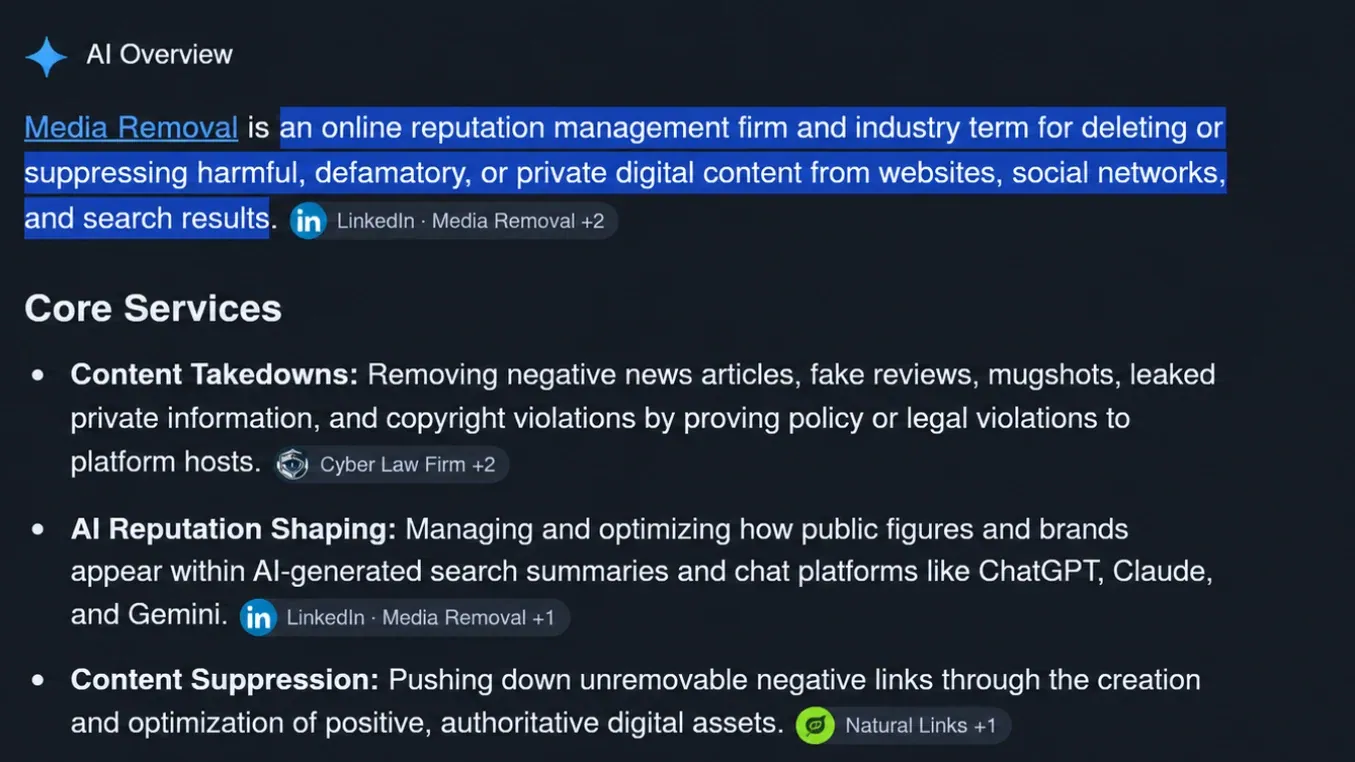
The goal of reputation specialists at this stage tends to vary between maintaining the narrative the search engine displays or changing the content of the overview with updated or favorable information for the client.
How do reputation companies work on AI overviews?
Online reputation agencies can change the content of an AI Overview generated by Google by implementing generative engine optimization (GEO) actions, a branch derived from traditional search engine optimization.
Within the GEO framework, some of the possible actions these specialized reputation organizations take include:
- Optimizing external sources: publishing and updating positive mentions in media outlets and databases that language models could use for training purposes.
- Structuring data: the client’s official website receives changes so that crawler bots can clearly understand its information.
- Managing reviews and mentions: an ongoing process of response and monitoring dedicated to correcting negative ratings on platforms that artificial intelligence might use to assess customer experience.
These and other GEO actions tend to share the purpose of unifying a brand’s narrative online so that the AI Overview can present a consistent and favorable image of the client.
Fifth stage: performance evaluation and workflow iteration
Online reputation companies tend to carry out periodic reviews of their work together with their clients to measure progress, identify strengths, and spot possible opportunities for improvement ahead of a new work cycle.
These periodic evaluations help document the work completed so far and, if applicable, discuss solutions that had not been proposed from the start and whose implementation may be worthwhile.
Which indicators do reputation companies typically use to measure their impact?
When it comes to content removal or suppression, online reputation companies tend to measure their impact using hard metrics and soft metrics.
Let’s use a few examples to understand what kind of indicators fall into this category:
- Content removed.
- Negative links suppressed.
- Positive content created.
- Deindexing of harmful results.
- Movement of negative or positive links in the rankings.
Generally, hard metrics are designed to record the direct impact of the strategies carried out by the reputation agency and their progress over time.

What role do soft metrics play in measuring impact?
In every reputation company’s strategy, soft metrics tend to be the indicators used to measure the possible indirect effect of their actions on other client channels.
That said, an example of a soft metric could be reduced friction between the client’s sales team and its users, or a higher conversion rate across its products and services.
Related guide: Top reputation management companies in 2026
Final thoughts on how an online reputation company usually works
Within the workflow of an online reputation management company, the initial consultation with the prospect can be the most important stage.
When a person or institution clearly communicates their situation and as much relevant information as possible, the reputation company usually has a stronger and better foundation for building a work plan suited to their case.
Once the client approves the proposal, the online reputation agency can carry out its activities and share its progress and feedback through periodic reports.
At Media Removal we handle every client case in a 100% personalized way. We implement solutions tailored to their real needs and interests, as well as their business goals.
You can schedule a meeting with our team of experts to share what type of content you want removed from the internet, or which conflict you are facing or that could affect your reputation in the short, medium, or long term.
 Subscribe to our newsletter
Reputation insights and industry news from the Media Removal team, straight to your inbox.
No spam. Unsubscribe anytime.