Summarize this post with:
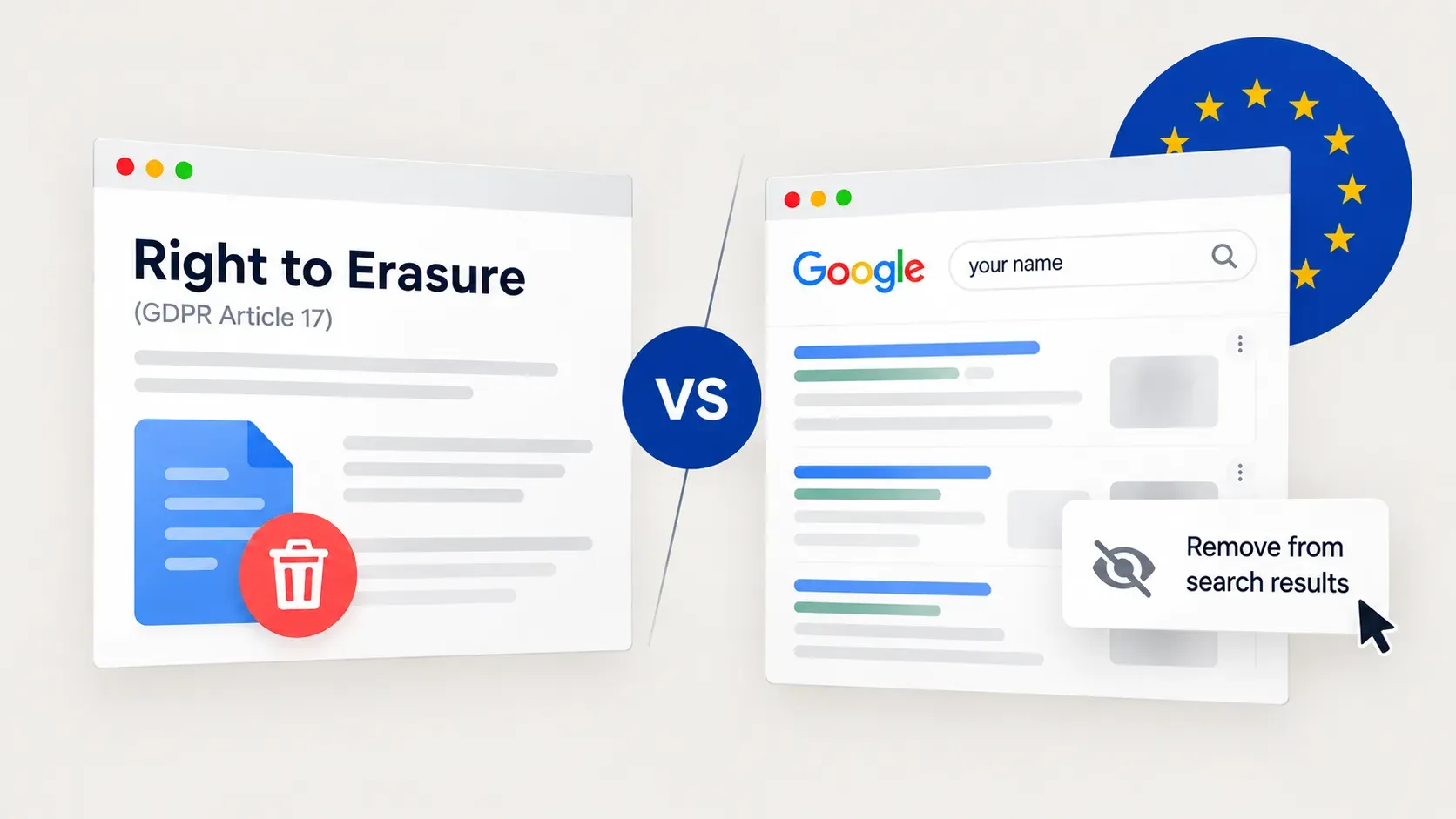
The right to erasure allows European Union citizens to request the deletion of their personal data from the entities that manage it.
When this right is invoked as a legal safeguard, and unless another circumstance prevails, institutions are obligated to delete the requester’s data from their systems.
A data deletion request based on the right to erasure can be much simpler if you have a request form template that lists the information you would need to provide for the case.
What Is the Right to Erasure?
The right to erasure is a legal power held by European Union citizens that allows them to request that their personal data be deleted from the systems of the entities that hold it, such as a company, store, or subscription service.
This power is described in Article 17 of the EU’s General Data Protection Regulation (GDPR), which applies solely and exclusively to member countries.

The right to erasure is not an unlimited legal power, since there are circumstances under which a request can be rejected and the data can remain intact.
How Can I Exercise the Right to Erasure?
A person can exercise their right to erasure by submitting a formal erasure request to the entity that manages the data and sending that request to the institution’s physical headquarters or a contact email address.
In a request to delete personal data under GDPR, some of the information that may be included would be:
- Details of the person making the request.
- Details of the data subject (if different from the requester).
- Information about the entity currently managing the data.
- Which data is being requested for deletion.
- Reasons that would justify the erasure of the information.
In addition to these items, it may be necessary to include copies of identification documents from the requester and/or the data subject, as well as any evidence that can support the petition.

Take back control of you online reputation
We can review your case and offer a personalized solution to help you take back control of what’s being said about you or your business online.
Example of a Data Deletion Request Form Based on the Right to Erasure
The official GDPR website has a sample form available to the public. However, using it is not mandatory, since it only serves as an example so that requesters understand what type of information they can include.

That said, there can be simpler and easier-to-use forms for the average person. Here is an example of a request template you can use to request the deletion of your personal data, which can simplify your process considerably:
To the attention of the data protection and management officer of [COMPANY]
[Contact email address]
Subject: Exercise of the Right to Erasure
In [City], on [Day] of [Month], [Year]I, [Full Name], of legal age, holding identification document number [Your document number], with an address for notification purposes at [full address], email [Your email].
I hereby SUBMIT THE FOLLOWING REQUEST:
In accordance with Article 17 of the General Data Protection Regulation (GDPR) or applicable data protection law, I am exercising my right of erasure regarding the personal data your entity holds on record.
I REQUEST that the following be carried out:
- The deletion of all my personal data under your possession or control.
- Notification to any third party to whom my data has been disclosed, so that they may also proceed with its deletion.
I am attaching a copy of my identification document to this request to verify my identity. I look forward to your response confirming the deletion within the legally established one-month period.
Sincerely, [Name and Signature]
What Happens If the Data Controller Does Not Respond to the Request?
If the organization never responds to your case, it is violating a fundamental right of European Union citizens, and it may face various financial penalties and mandatory content deletion orders.
Once the organization receives the formal request, the institution has a maximum period of one month to respond to the request.
This time limit can be extended, however, as in more complex cases the company may have an additional two months to provide a response.
Exercising the Right to Erasure Can Be Simple With the Right Template

When a person has the right template to make their data deletion request based on the right to erasure, the process tends to have a higher chance of success.
The reason is that a template usually helps structure a request better, avoiding misunderstandings or gaps in information that could compromise the petition.
However, there can be situations where the document alone is not enough to get the data deleted. In these cases, having a partner who specializes in content removal can be preferable.
At Media Removal, we help institutions and individuals gain greater control over their information. We develop action plans that include the protection of the right to erasure and other resources that may be useful.
If you need support with an information removal process where the right to erasure alone is not enough, you can schedule a meeting with our team so we can start building a plan of action tailored to you.
 Subscribe to our newsletter
Reputation insights and industry news from the Media Removal team, straight to your inbox.
No spam. Unsubscribe anytime.