Summarize this post with:
In Article 17 of the General Data Protection Regulation (GDPR), the European Union establishes the “right to erasure” and the “right to be forgotten.”
Both concepts share a common goal, which is to help individuals maintain a degree of control over their personal information when that information should no longer be publicly available.
However, the right to erasure and the right to be forgotten carry distinct legal nuances that affect how each regulation applies if you need to remove your personal information from the internet.
What is the right to erasure?
The right to erasure is the official name used by the European Union’s General Data Protection Regulation in Article 17.
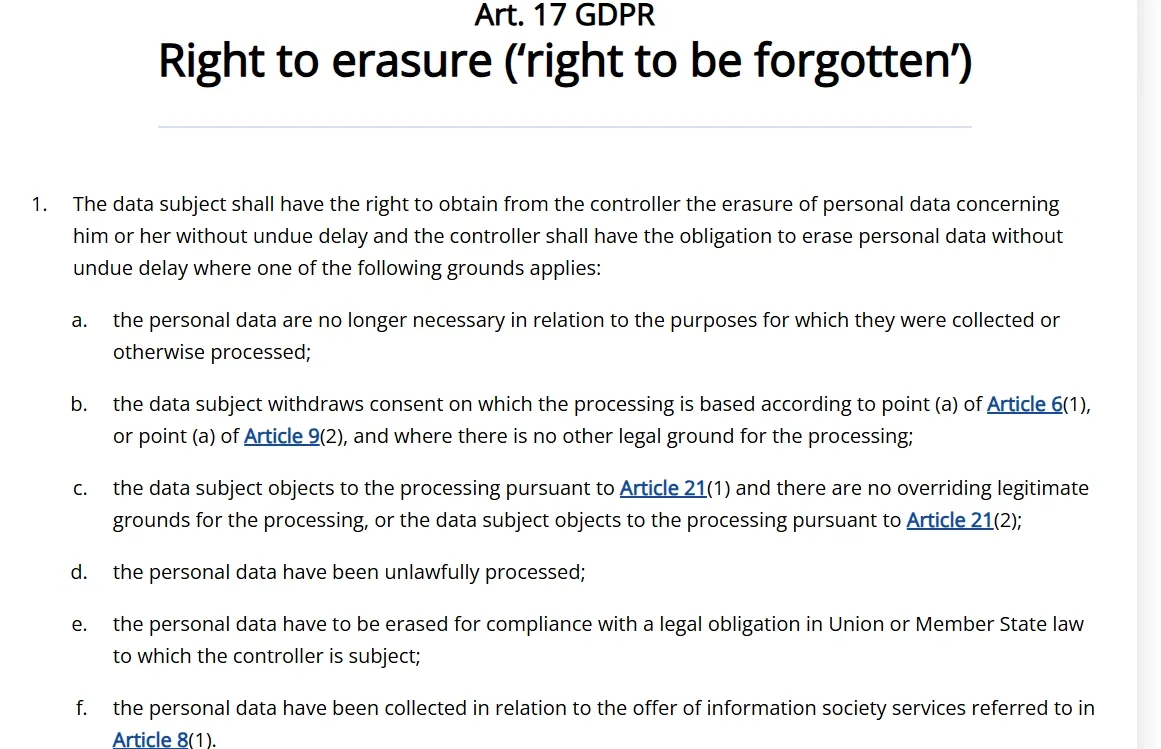
This article states that the owner of a set of information has the right to request the deletion of their data from the entities that manage it, and that these entities are obligated to erase the data under any of the following circumstances:
- The data is no longer necessary for its original purpose.
- The data subject withdrew their consent for the processing of their data, and there is no other legal basis to support its continued management.
- The data subject objects to the processing of their data, and there is no legitimate reason that overrides their request.
- The data was processed unlawfully.
- The data must be erased so the data subject can comply with a legal obligation within the European Union.
- The information belongs to a minor and was collected in the context of information society services.
In this sense, the right to erasure can be understood as a broad tool, since a person can invoke it in relation to any company or organization that holds their personal data.
It’s worth noting that this regulation applies only within European Union member states, so anyone wishing to pursue a similar remedy in their own country or elsewhere must rely on local legislation instead.
What is the right to be forgotten?
The right to be forgotten is the ability individuals have to request that search engines remove their personal information from search results pages.

The right to be forgotten predates the GDPR itself, since its origin traces back to a 2014 court case, while the General Data Protection Regulation was approved in 2016 and took effect in 2018.
Where did the right to be forgotten originate?
The first legal precedent for the right to be forgotten took place when Spanish citizen Mario Costeja requested that Google stop displaying his name in connection with a 1998 real estate auction tied to a Spanish Social Security debt seizure.
The court ruled in his favor and established that individuals can ask search engines to remove links related to their name from search results, even if the original information on the source website remains legal.
The GDPR incorporated this precedent into Article 17. As a result, the right to be forgotten coexists with the right to erasure within the same legislation, even though their origins and how they’re applied remain distinct.

Take back control of you online reputation
We can review your case and offer a personalized solution to help you take back control of what’s being said about you or your business online.
What is the difference between right to erasure and right to be forgotten?
Although both concepts coexist within the same article of the European Union’s General Data Protection Regulation, there are four key distinctions that are useful when deciding which request to file.
| Differences | Right to erasure | Right to be forgotten |
|---|---|---|
| Who receives the request? | The data controller. | Search engines (Primarily Google). |
| What information gets removed? | The requester’s personal data. | Links associated with the requester’s name. |
| Where is it removed from? | The data controller’s system | The search engine’s results page. |
| Does it erase data at the source? | Yes, the data is deleted from the controller’s system. | No, the content on the original source remains intact. |
When you exercise the right to erasure with Google, what gets removed are the links associated with your name in search results, but the original source of the data remains intact and still accessible through other means.
If someone asks Google to remove a link to an old news article about them, the search engine may delist that result, but the article will still be published on the outlet’s website, and anyone with direct access to it will still be able to read it.
When should you apply each right?
When choosing between the right to erasure and the right to be forgotten as the basis for a request involving your personal data, two factors can help you decide:
- Where your data is currently hosted.
- The outcome you want to achieve.
If your information is stored in the database of a service platform or a former employer, basing your request on the right to erasure may be preferable, since your target would be the institution that directly manages your data.
However, if the problem is that Google is displaying harmful content and linking it to you, the more direct path is usually to file the request with the search engine itself, based on the right to be forgotten.
Can I use both rights in a single process?
Yes, you can use the right to erasure and the right to be forgotten within the same removal process, since these two remedies tend to complement rather than contradict one another.
It’s common to first request the deletion of data at its original source under the right to erasure, and then ask Google to remove the corresponding link under the right to be forgotten.
Final thoughts on the right to erasure and the right to be forgotten

Understanding the difference between right to erasure and right to be forgotten can help you prepare the correct request from the very first attempt.
In practice, many online reputation issues involve both fronts at once, since harmful content may be hosted on a website while that same content also ranks near the top of Google when someone searches your name.
In these scenarios, if working directly with the company or the search engine doesn’t move forward satisfactorily, having the support of a specialized partner can make the removal process easier.
At Media Removal, we have a team of reputation experts who can help you identify which right applies to your case and manage the request with the appropriate institution or search engine.
You can schedule a meeting with us to walk through your particular situation and the results you need, so we can build a solution tailored to your case together.
 Subscribe to our newsletter
Reputation insights and industry news from the Media Removal team, straight to your inbox.
No spam. Unsubscribe anytime.