Summarize this post with:
Before putting money into a Trustpilot subscription, any business owner would wonder whether it’s worth paying for Trustpilot Business plans.
The answer to this question is more complex than you might think.
Trustpilot’s pricing page shows “starting from” figures, but what you end up paying depends on how many domains you manage, how many review invitations you send, and whether you need access to advanced data.
On top of that, there are other important aspects to consider, such as the payment term of the plans, automatic renewal, and the price per domain.
For this reason, understanding Trustpilot’s pricing structure lets you know what each plan unlocks, which features you would be left without, and at what point the price stops making sense for your case.
How much does Trustpilot Business cost in 2026
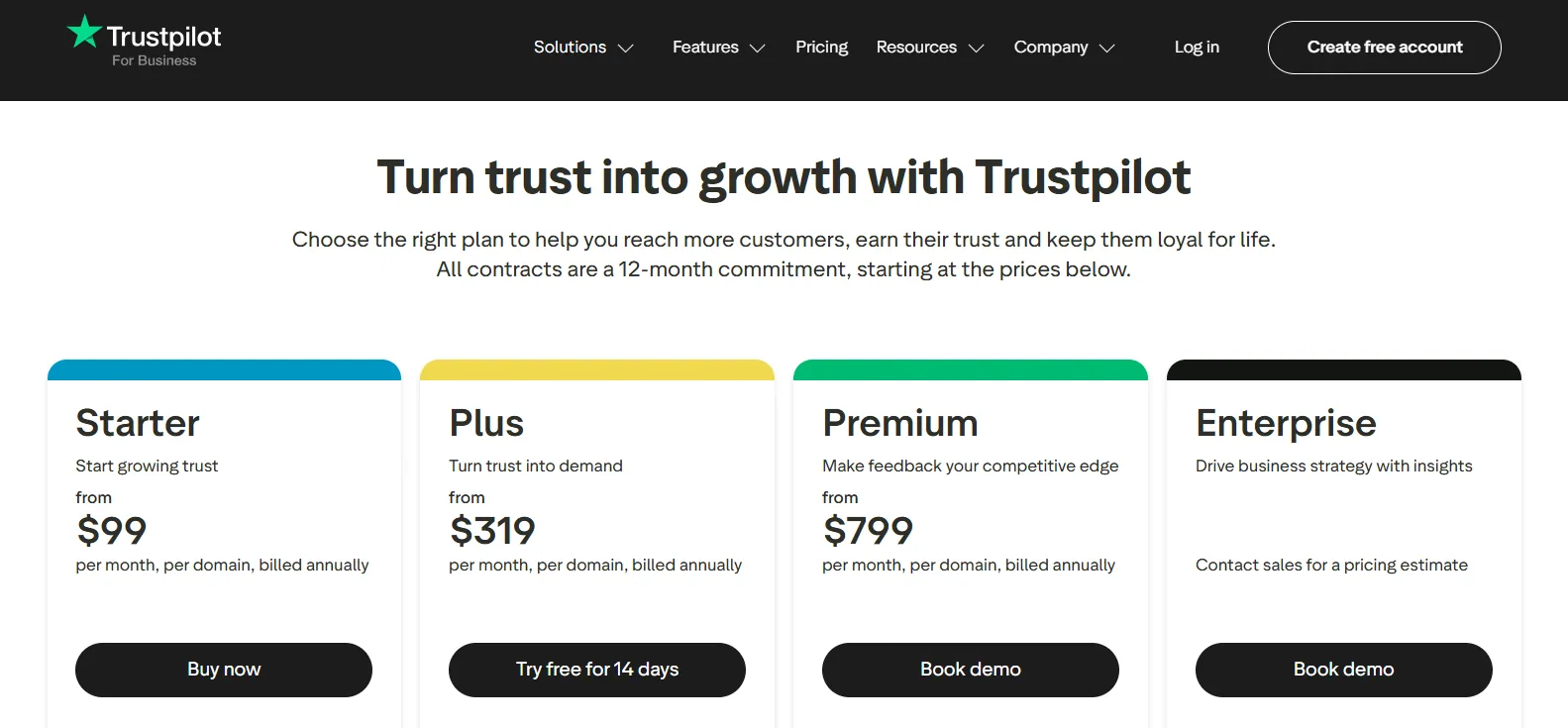
The table below shows Trustpilot’s updated pricing for 2026 (for the United States):
| Plan | Approximate price (per domain, annual billing) | Intended for |
|---|---|---|
| Free | $0/month | Claiming the profile and responding to reviews, with no active invitations |
| Starter | From $99/month | Small businesses just starting to collect reviews |
| Plus | From $319/month | Mid-volume companies that want to customize and optimize |
| Premium | From $799/month | Growing businesses with advanced analytics and multiple domains |
| Enterprise | Custom quote (usually above $2,000/month) | Large organizations, multi-brand, and with API needs |
One important detail: these figures are entry points, not the final price.
Over a full year, the “Plus” plan comes to around $3,828 and “Premium” around $9,588, and that’s before adding extra domains or negotiating the contract.
Many comparisons still cite Trustpilot’s previous structure (with plans like Plus at $259 or Advanced at $1,059), which became outdated after the 2026 price change.
What do the paid plans unlock compared to the free one?
The free plan does little more than keep you present: you can claim your profile, respond to reviews, and add a basic badge, but you can’t actively request reviews from your customers. That’s where the real difference between paying and not paying lies.
These are the features that only appear starting with the paid plans:
- Sending review invitations.
- Profile brand customization (logo, colors, design), available starting with the “Plus” plan.
- More widgets to display your TrustScore and your reviews across various pages of your site.
- Advanced analytics, trend analysis, and competitive intelligence, which are reserved for the “Premium” plan onward.
In practice, the free plan isn’t enough to build momentum, and that’s precisely why Trustpilot pushes toward the paid plans from the very start.
The hidden costs that don’t appear on the pricing page
This is where many small businesses get a nasty surprise.
The monthly price you see doesn’t tell the whole story, and some contract terms weigh more than the fee itself.
These are the costs worth being clear about before signing:
- Prepaid 12-month annual contracts: you pay for the full year up front and, once it starts, it’s non-refundable even if you stop using the platform halfway through.
- Automatic renewal: the contract renews on its own unless you send a written cancellation before the renewal date.
- Price per domain: if you manage several sites, the cost multiplies, since the “Plus” plan covers up to 3 domains and “Premium” offers unlimited domains, but each extra domain still carries its own cost.
- Monthly billing surcharge: when there’s an option to pay month to month, it usually adds around 20% on top of the annual price.
The result is that a subscription that looked like it cost a few hundred dollars a month can turn into an annual commitment of thousands, especially if you add domains.
The price matters as much as the plan you choose, although Trustpilot often offers discounts for volume or for multi-year contracts.
Does the price change based on your country or type of business?
Yes, the price varies by region and currency.
Trustpilot is priced in dollars for North America and in euros or pounds for the European market, with amounts that adjust to each zone.
Since these figures change frequently and don’t always match those on other regional pages, the safest bet is to check the price on your local version of Trustpilot before signing up.
As for the type of business, the price doesn’t change because you’re an online store: online stores pay the same tiers as any other company. What does change is the profitability.
For an ecommerce or SaaS business, where the customer researches on search engines before buying, a solid Trustpilot profile has direct commercial value.
However, for a local service (a restaurant, a dentist, a repair shop), Google and other platforms tend to influence the purchase decision more.
Which plan do you need to use the Trustpilot API?
If your goal is to connect Trustpilot with your own systems, this is the part that interests you most. API access is not included in the basic plans.
The API is available starting with the “Premium” plan and in “Enterprise”, usually as an add-on.
So, is it worth getting Trustpilot Business?
The answer to this question comes down to one decision: Do your customers use Trustpilot to decide whether or not to buy? If the answer is yes, a well-managed profile can more than pay for itself.
It makes sense to pay when you have enough customer volume to take advantage of the invitations, when you compete in a sector where online trust carries weight, and when the profile shows up in searches for your brand.
It makes less sense when you’re a very small business, with few transactions a month, or when your reputation is at stake on other platforms.
In that case, the annual commitment can be an expense you don’t recoup.
What a Trustpilot subscription can’t solve for you
In the end, a paid Trustpilot plan is a good tool for requesting and displaying reviews, but it’s not a shield for dealing with negative reviews.
When a negative review from a real customer appears, Trustpilot only removes it if it goes against its policies, and proving that is harder than it seems.
That’s where understanding your reputation as a whole changes things: collecting reviews is only the start, and the rest comes down to knowing what to do with the negative content that’s already published and weighing on your brand.
If you’re at that point, at Media Removal we support companies that need to regain control of their digital reputation, remove negative reviews on Trustpilot, and clean up the negative content that a review plan will never resolve on its own.
Before signing an annual contract, it’s worth keeping in mind that, sometimes, the best investment isn’t the most expensive subscription, but the strategy that protects what your customers see of you.
 Subscribe to our newsletter
Reputation insights and industry news from the Media Removal team, straight to your inbox.
No spam. Unsubscribe anytime.