
How does a negative review affect a business?
The question is: Are you controlling the narrative?
Businesses can lose up to 30 customers just based on ONE bad review…
bad reviews and you’re pushing close to 100 lost customers.
Here’s the science behind customer psychology before and after seeing reviews.
BEFORE a lead sees reviews, their brain is running on uncertainty. They only know your name, offer, and whatever teaser your ad or cold email gave them.
In psychology, this is called a high-risk, low-information state. When people feel uncertainty, their brain immediately starts playing defence:
“Is this legit?” “Can I trust them?” “What’s the catch?”
They start asking everything under the sun to “justify” their skepticism and doubts.
Some of the most common questions appear under “people also ask”.
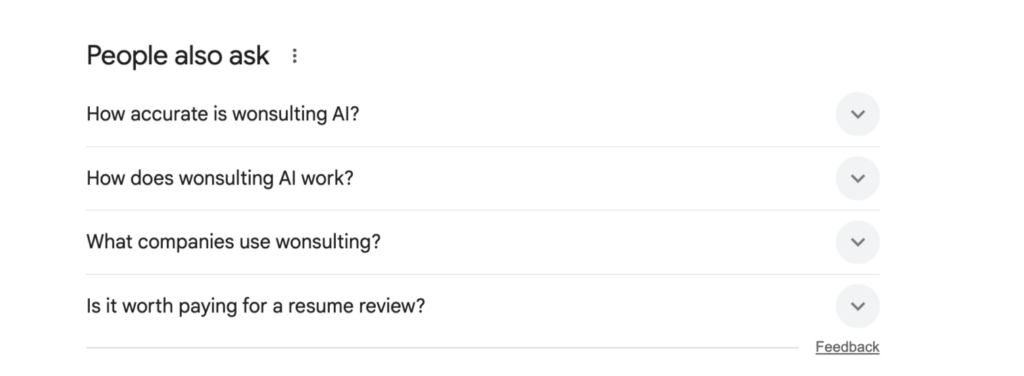
This is why searching your brand + ‘reviews’, ‘scam’, or ‘legit’ is an automatic reflex.
They’re trying to reduce risk before they waste time or money.
AFTER they see reviews, everything changes in a matter of moments.
Research shows online reviews directly shape three psychological triggers
1.
Trust Activation
Positive reviews release a “trust shortcut” in the brain called social proof. People trust people like themselves more than any marketing message you’ll ever write.
2.
Decision Momentum
Eye-tracking studies show that once someone reads just one negative review, their attention shifts from “Is this the right solution?” to “Should I avoid this?”
3.
Risk Reduction
Negative reviews, on the other hand, spike perceived danger… look at this one and ask yourself how you feel:
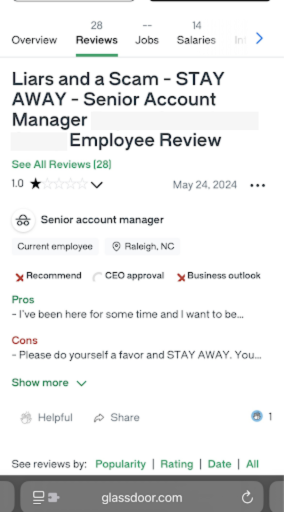
And the brain is wired to amplify negative signals by up to 4–5 times more than positive ones
In simple terms
Our lead is open, curious, and neutral (but cautious). Then it’s either one of the 2 outcomes.
Their brain enters defence mode, trust collapses, and they start hunting for your competitors.
Their brain enters confidence mode, trust increases, and they become far more likely to click, book, or buy.
And it only takes ONE negative review to trigger that shift.
That’s the scary part!
One bad Reddit thread.
One old Trustpilot 1-star.
One angry ex-client who typed faster than they thought.
Just like that, their 30-second Google search becomes the lens through which they see your entire business.
Let’s paint a picture of proven behaviours that negatively impact businesses
It all starts with the first touch point from a cold lead with your business.
- An ad.
- A cold email.
- A social media post…
- A referral.
After getting one of these touch points, the cold/warm lead (depending on the lead gen source), decides to look up your company name
At this point, all they know about you is your company name, AKA, very LITTLE about you.
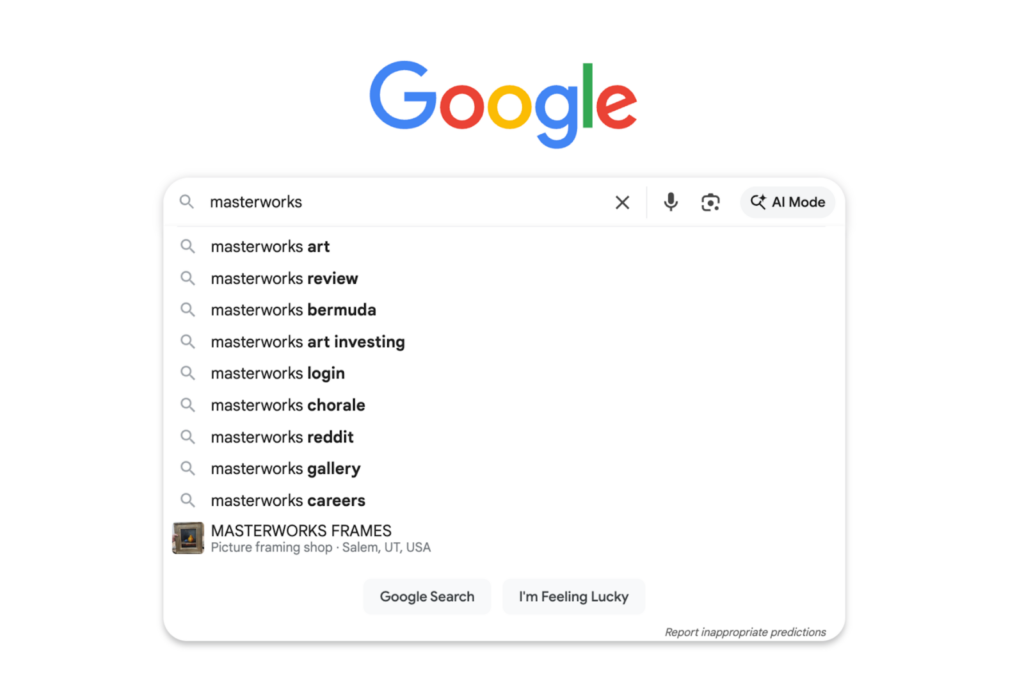
While typing…the Google search bar will automatically suggest commonly searched keywords…
The Google Autocomplete often includes the highest ROI keywords (negative or positive), depending on the attention you’ve been receiving for your online reputation.
This is heavily influenced by the most popular and trending user search queries, ultimately making it out of our control to “control” the Google Autocomplete suggestions
Some of the Google autocomplete words include: “REVIEWS”, “SCAM”, “LEGIT”, “COST”, “WORTH IT”…
After clicking ANY of these suggested searches
The very first thing the lead sees is the top 3 ranked results for that respective keyword
For the word “REVIEWS” it typically leans toward being a review directory / Reddit, Quora, and the AI Overview
90% of the time, Reddit results for companies tend to be NEGATIVE
and 50-60% of businesses have Trustpilot scores below 4,3-4,5 Stars
If Reddit is negative and there’s more than 3-5 negative 1-star reviews on Trustpilot the AIO will share a “mixed reviews” overview in negative and positive opinions as it picks up from respected sources with high domain authority (DA) related to reviews.
Here is an example of a well-optimized Google AIO with Google citing several positive and reliable sources.
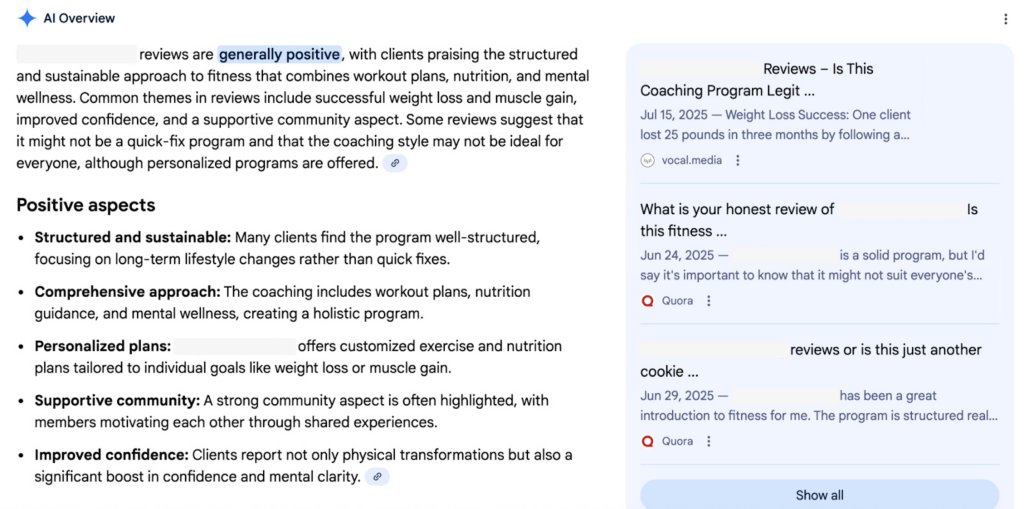
And here is an example of a poorly-optimized Google AIO citing a negative Reddit post:
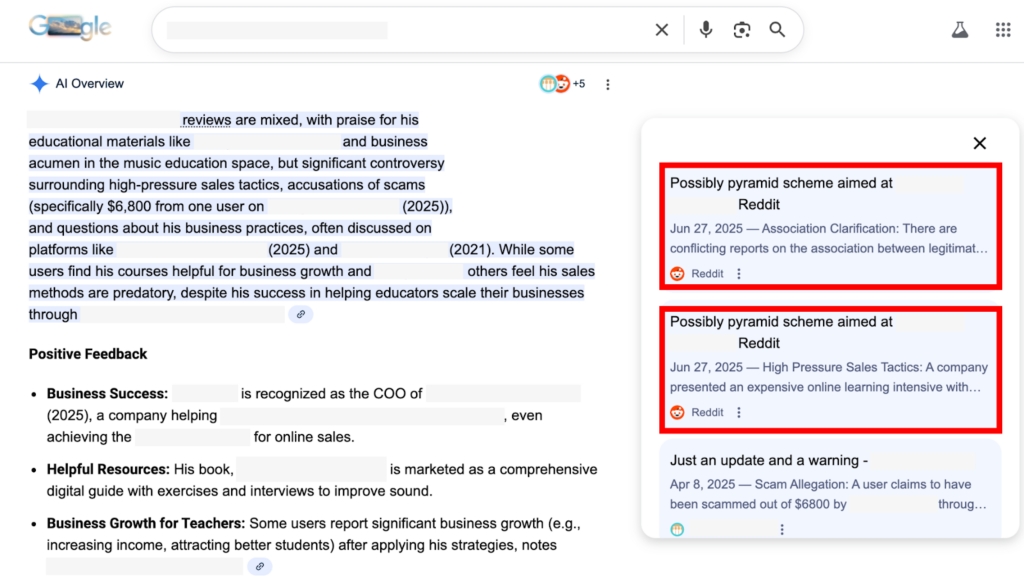
If the POSITIVE content doesn’t outweigh or outperform the negative content by at least triple the visibility, based on ranking authority and click-through data, then you’re screwed…
Here’s why…
The lead is automatically playing defence and putting up walls as this first impression is now an impression of skepticism / potential scam allegations / negative case studies, and much more
At this stage, the lead either:
- Searches for the same service on Google but for “better” solutions with solid reviews or better brand reputation (depending on the lead’s urgency for solving their problem).
OR
- They leave this for another day and automatically disregard your company as a potential, credible option for their need.
Now, if the lead comes across a direct competitor (based on how well they rank for the product/service keyword – basic SEO),
And if the competitor’s reputation is just slightly better, or far better than yours for that matter, without any ranked negative reviews on the first page of Google…
Well, your competitor just “stole” your lead without even trying.
BUT WAIT,
It’s not just handing free leads to the competition or killing a lead source (without even knowing)… There’s more to it.
Let’s be honest, how many leads do you think got lost in transition from your lead source to your DM’s or mail inboxes?
How many more warmer leads (due to all the pre-nurturing ORM does for a business) could you have closed?
Now here’s where it gets tricky…
If someone books a call with your sales team, and they’re eager to jump on, they’ll probably look you up or your business about 5 minutes before the meeting (or the night before).
Let’s say the lead decides to type in a negative sentiment keyword like “SCAM” to make sure there are 0 negative allegations about your company…
BUT, there’s this one OLD fake and defamatory review an angry customer left to try and damage your business because they couldn’t get XYZ…
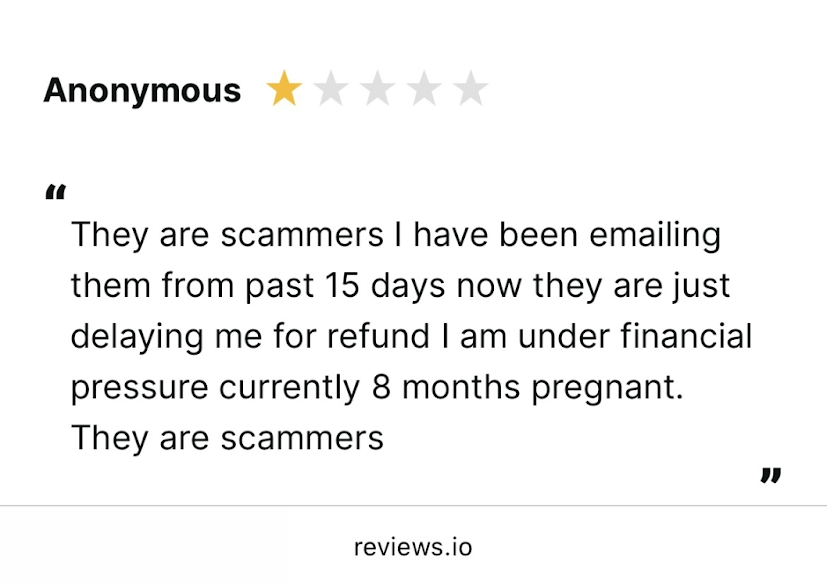
This is why searching your brand + ‘reviews’, ‘scam’, or ‘legit’ is an automatic reflex.
They’re trying to reduce risk before they waste time or money.
AFTER they see reviews, everything changes in a matter of moments.
What would your reputation look like under negative keywords with positive content ranking instead?
“How is that even possible?” you might be asking…
Let me show you.
Here is an example of negative content ranking for a negative keyword:
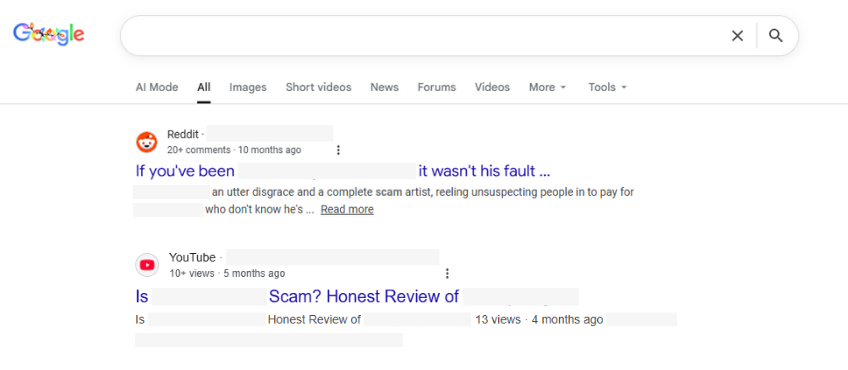
You’ve just left a closed deal on the table. Or at least, a potential client who was supposed to speak with your top-performing closer.
Only because of negative content from ONE (or multiple) negative review(s).
And it gets worse, if that review was on Reddit, it probably got +10 more comments about people who have NEVER bought from you, talking shit about your products.
Very typical of Reddit, isn’t it?
Small disclaimer
By all means, ORM is not a quick fix or an easy one. Neither will it “fix” your business overnight.
But just like SEO, good things take time; Google needs to see all the work you’re doing online to serve every client with excellence as a business.
We typically see 180-degree changes in businesses’ ORM within 180 days (6 months), up to a full year (365 days).
While starting to see first see tangible results around months 2 and 3.
It’s not just a negative review we’re talking about. It’s the first impression your business gets.
Don’t let it be your last.

Take back control of your online reputation here ➔ mediaremoval.com