Over 300 companies trust Media Removal. Get a Quote Now >
Reputation Crisis on Trustpilot: How to Handle a Wave of Negative Reviews


By Pablo M.
Posted

Estimated reading time
Watching negative reviews pile up on Trustpilot can become one of the most exhausting experiences for any business, especially when the feeling of losing control sets in faster than expected.
On top of that, there’s an uncomfortable reality: Trustpilot doesn’t allow you to remove opinions at will, and every new low rating drags down your TrustScore, customer trust, and conversions.
Many brands react too late or in the heat of the moment, making decisions that end up making things worse while the comments stay visible and search engines index them.
Understanding how the platform works and which steps can make the difference between a successful negative review management strategy and one that falls short is what separates the brands that come out stronger from the ones that get caught up in the noise.
What qualifies as a reputation crisis on Trustpilot?
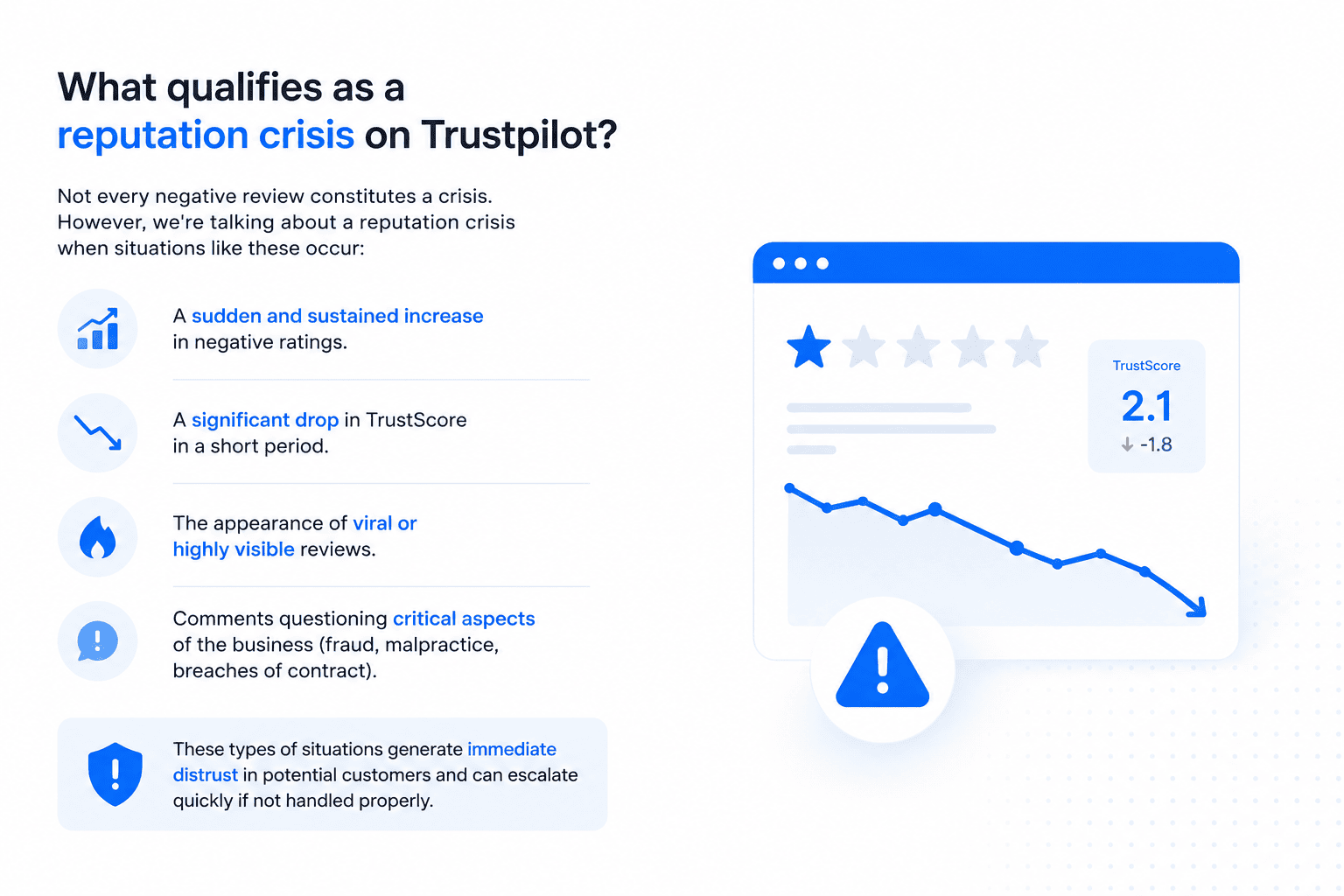
Not every negative review constitutes a crisis. However, we’re talking about a reputation crisis when situations like these occur:
- A sudden and sustained increase in negative ratings.
- A significant drop in TrustScore in a short period.
- The appearance of viral or highly visible reviews.
- Comments questioning critical aspects of the business (fraud, malpractice, breaches of contract).
These types of situations generate immediate distrust in potential customers and can escalate quickly if not handled properly.
How does Trustpilot work and why is it nearly impossible to remove negative reviews?
Trustpilot operates as an open platform where any user can share their experience with a company. Its system is designed to protect transparency, which means that:
- Companies cannot remove reviews on their own.
- Only opinions that violate the guidelines (spam, fraud, offensive language, etc.) are removed.
- The review process can be slow and not always favorable.
This puts many companies in a frustrating scenario: even unfair or exaggerated reviews can remain visible.
The role of the “TrustScore” and its impact
Trustpilot’s reputation system is based on what’s known as the “TrustScore,” a score that reflects the weighted average of all reviews received.
This indicator has the following characteristics:
- It’s publicly visible and easy to interpret.
- It directly influences perceived credibility.
- It updates constantly based on new opinions.
The impact of the TrustScore on conversion rates
Multiple studies have shown that even a 1-point difference in average rating can significantly affect purchasing decisions.
Additionally, a low TrustScore on Trustpilot can lead to:
- Reduced conversions on sales pages.
- Increased abandonment during the buying process.
- Greater price sensitivity (users demand more guarantees).
On the other hand, a high score acts as social proof and reduces friction in the customer’s decision-making process.
When Trustpilot reviews become a business risk
When negative reviews pile up unchecked, they stop being a one-off issue and become a real risk for the business:
- Long-term brand damage.
- Loss of positioning against competitors.
- Impact on marketing campaigns (especially cold traffic).
- Negative content appearing in search engines like Google.
At this point, it’s no longer just about managing opinions, but about protecting the company’s most important asset: its reputation.
How to act during a negative review crisis
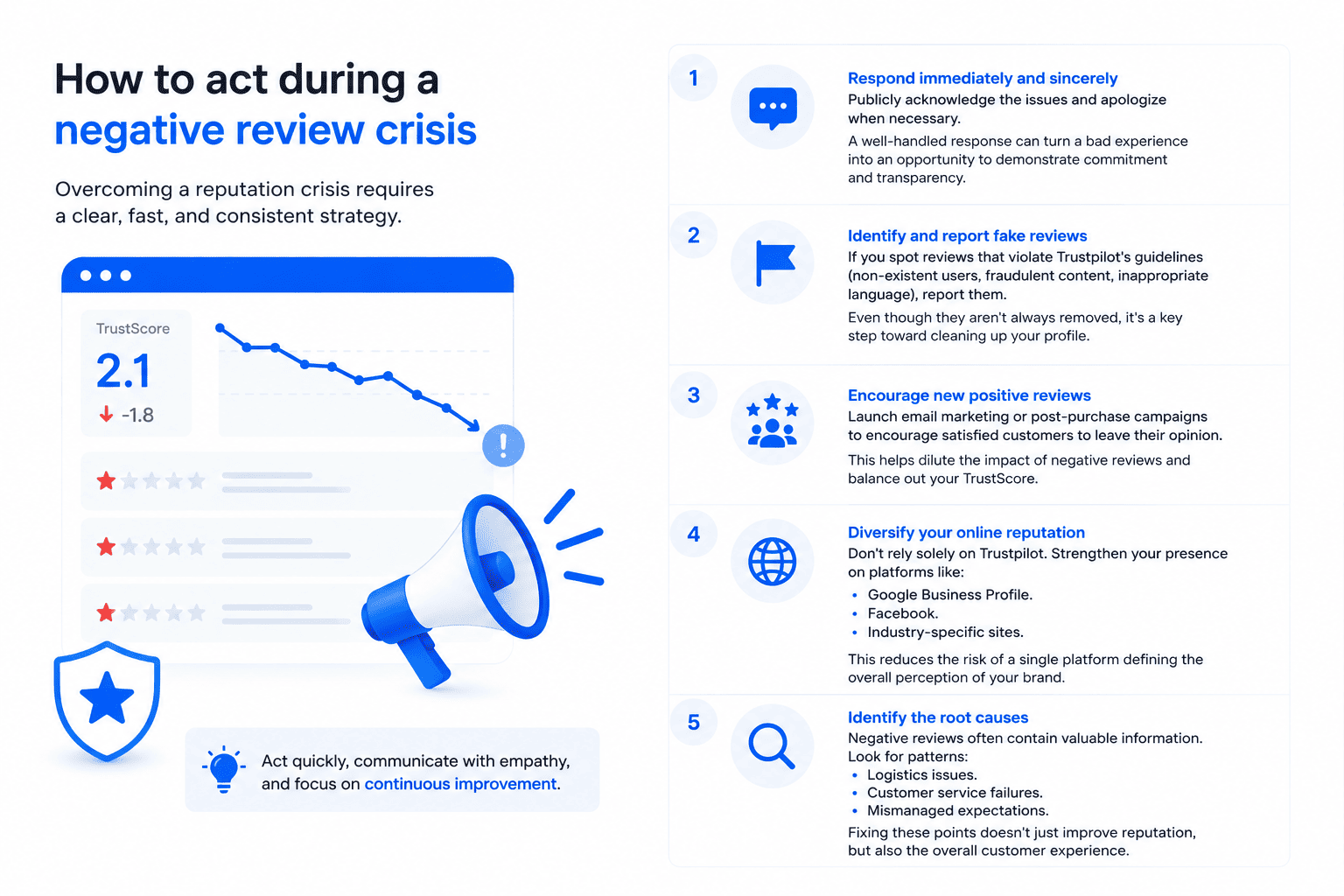
Overcoming a reputation crisis requires a clear, fast, and consistent strategy.
1. Respond immediately and sincerely
Publicly acknowledge the issues and apologize when necessary.
A well-handled response can turn a bad experience into an opportunity to demonstrate commitment and transparency.
2. Identify and report fake reviews
If you spot reviews that violate Trustpilot’s guidelines (non-existent users, fraudulent content, inappropriate language), report them.
Even though they aren’t always removed, it’s a key step toward cleaning up your profile.
3. Encourage new positive reviews
Launch email marketing or post-purchase campaigns to encourage satisfied customers to leave their opinion.
This helps dilute the impact of negative reviews and balance out your TrustScore.
4. Diversify your online reputation
Don’t rely solely on Trustpilot. Strengthen your presence on platforms like:
- Google Business Profile.
- Facebook.
- Industry-specific sites.
This reduces the risk of a single platform defining the overall perception of your brand.
5. Identify the root causes
Negative reviews often contain valuable information. Look for patterns:
- Logistics issues.
- Customer service failures.
- Mismanaged expectations.
Fixing these points doesn’t just improve reputation, but also the overall customer experience.
What you shouldn’t do during an online reputation crisis
Some decisions can make the situation worse instead of solving it:
- Buying fake reviews (this can lead to penalties and loss of credibility).
- Trying to remove content through illegal means.
- Ignoring criticism or responding aggressively.
- Creating public conflicts with customers.
These practices aren’t just unethical, they can also worsen the problem in the long run.
What to do if Trustpilot reviews also appear on Google?
When Trustpilot reviews get indexed by Google, the impact multiplies.
In these cases:
- If you manage to remove a review on Trustpilot, also request its de-indexing on Google.
- If you can’t remove it, work on generating positive content to push it down in search results.
- Strengthen your brand SEO with your own content (website, blog, press releases).
The challenge here is that Trustpilot is considered a high-authority site, so its pages tend to rank well in search engines.
Final recommendations for managing a negative review crisis on Trustpilot
When a brand faces negative comments on Trustpilot, taking shortcuts seems like the easiest path. However, online reputation isn’t built by removing what’s uncomfortable, but by demonstrating consistency between what you say and what you do.
Real reputation is built from the inside out: every interaction, every product delivered, and every conversation with a customer adds small pieces that, over time, speak for the brand better than any digital strategy.
Diversifying your presence across platforms, official profiles, and owned channels also helps prevent a single criticism from defining the full picture.
If you feel that some unfair reviews or comments are affecting how your brand is perceived, at Media Removal we can help you review the situation calmly and figure out together which options fit your case.
We’re here to help you regain your peace of mind and protect what has taken you so much effort to build.

Take control of your online reputation
We can review your case and offer a personalized solution to help you take back control of what’s being said about you or your business online.