
2 reviews removed
Both unverified and left by people who had never been clients.
A property management firm’s Trustpilot profile sat at 2.9 stars from two fake reviews. How two removals cleared it to zero and set it to deindex.
That 2.9 was costing them. Prospects were landing on the profile, seeing the score, and moving on. The company knew their service was strong. The reviews did not reflect that.
The problem was not the volume of reviews. It was the opposite. On a thin profile, a single bad rating does all the damage, because there is nowhere for the average to hide. One 1-star review dragged the whole score to 2.9, and it was the first thing anyone researching the company saw.
In a trust-driven industry, a 2.9 raises questions before a conversation even starts.
These were not real clients. The profile was unclaimed, the reviews were unverified, and there was no record of these people ever working with the company. Two reviews doing outsized damage, on a page the business had no control over. The fix was not about burying the bad reviews under new five-stars. It was about removing what should never have been there.
We got to work on the removals immediately. Both reviews came down. With the profile now sitting at zero, we moved to have it deindexed from Google so it stops surfacing for the brand name entirely.
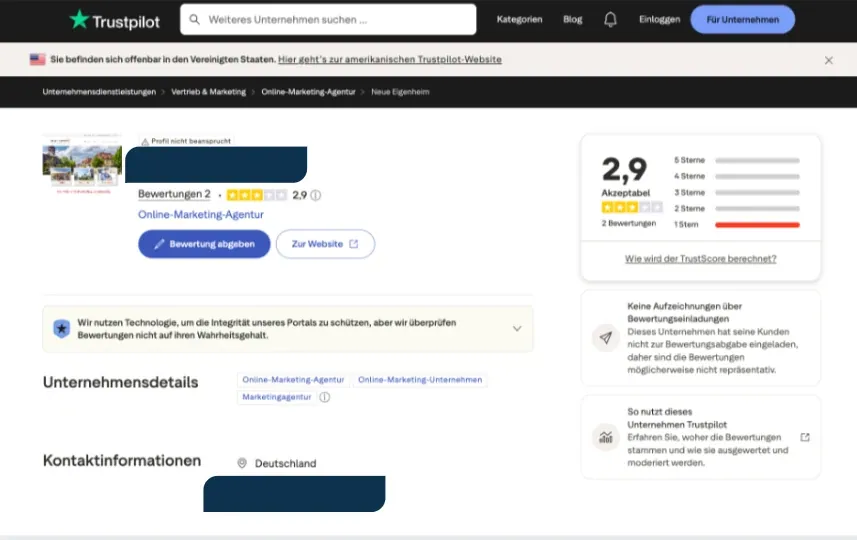
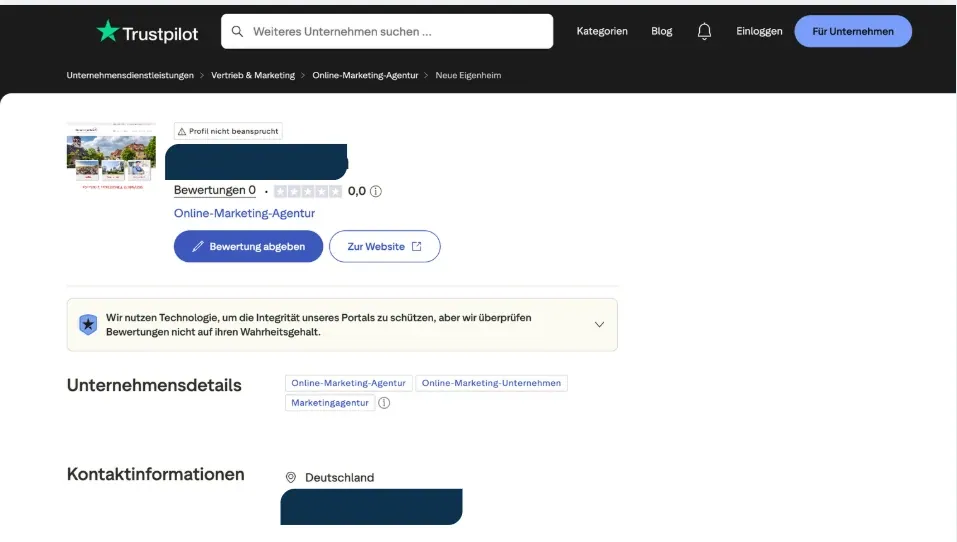
Here is why that works. On a large profile, a single one-star review carries the weight of ten five-stars. On a thin profile, that imbalance is even more extreme.
Two bad reviews were the entire rating. Remove them, and there is nothing left to hold against the brand. A profile with no reviews and no claim tends to fade from search rather than linger as a liability.
That is why removing the fake reviews, and letting an unclaimed profile fall away, often beats trying to out-review the problem. Sometimes a full profile deletion makes more sense than damage control.
Both unverified and left by people who had never been clients.
The score eliminated and the profile cleared of all activity.
The profile is set to drop from Google results for the brand name.
Today, that profile carries nothing against the company. The score is gone, the fake reviews are gone, and the page itself is on its way out of search entirely. What had been a liability tied to the brand name was cleared, not patched over.
The lesson is simple. If a couple of fake reviews are defining your brand, the fix might not be as complicated as it looks. Sometimes the fastest way to remove a negative Trustpilot rating is to remove the reviews creating it, and let the empty profile disappear on its own.
If a thin Trustpilot profile or a couple of fake reviews are dragging your rating down, tell us what is out there. We review it for free: what can be removed, and how far the score can move.
Get a free assessment