Researching a supplement before buying it often ends up raising a bigger question than the one you started with.
With Happy Liver, by Ritual Labs, that question keeps coming up on Trustpilot, on the BBB, and in dozens of comments mentioning unexpected charges and unclear cancellation processes.
Before deciding whether the brand is worth trusting, it is worth understanding what is behind those complaints and how widespread they really are.
This article reviews Ritual Labs’ business profile, the real weight of its negative reviews, and how all of this shows up today in search results.
What is Ritual Labs and how does it run its business?
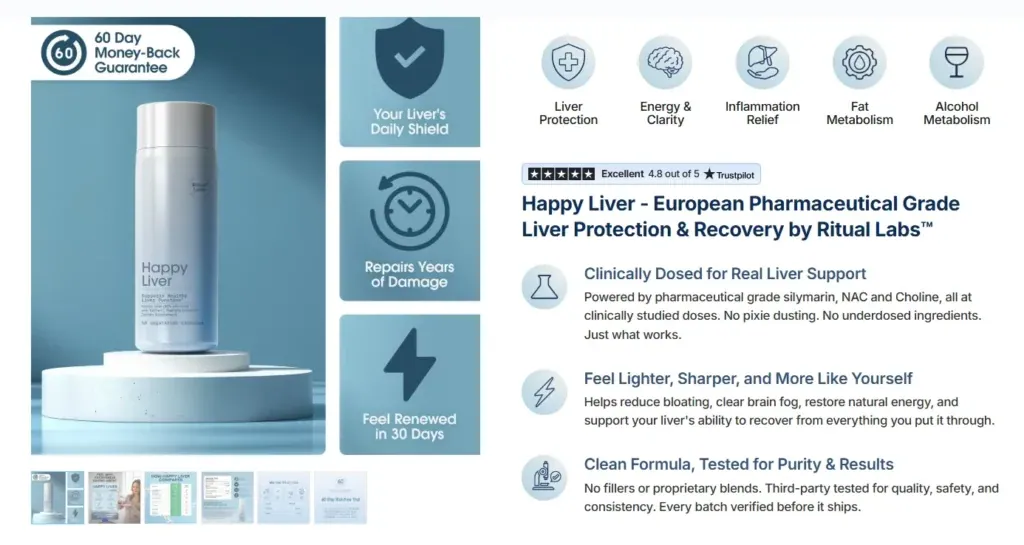
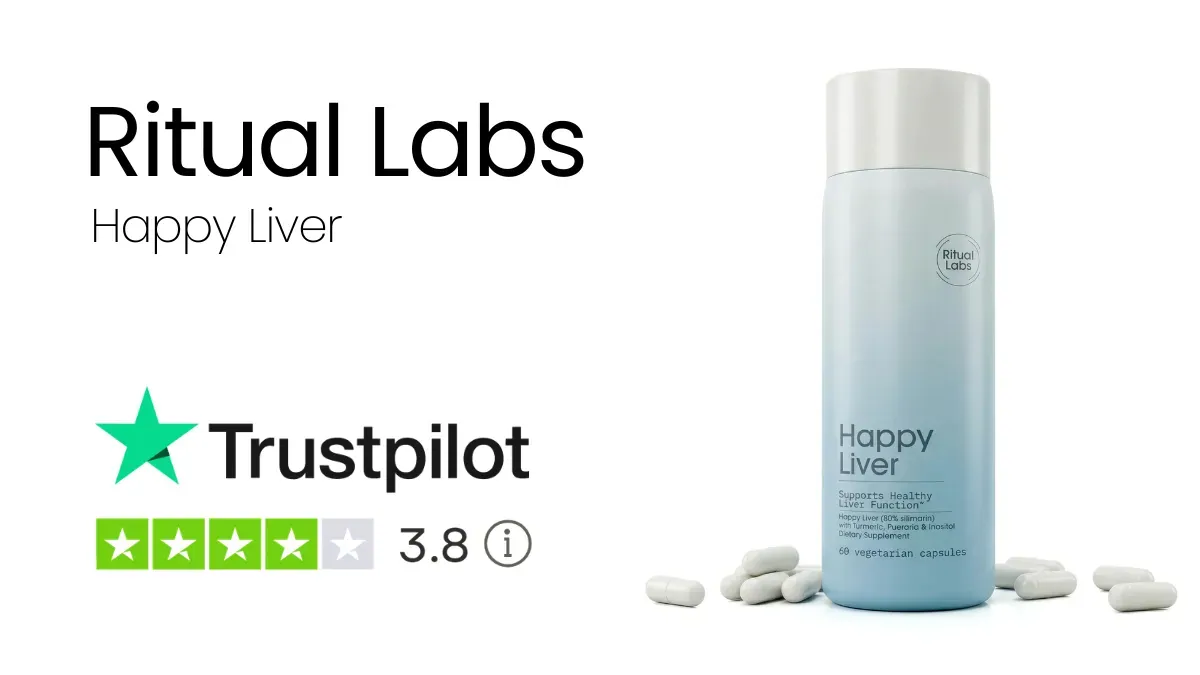
Ritual Labs LLC is a supplement company whose best known product is Happy Liver, a liver support capsule made with milk thistle, NAC, and choline.
According to its Better Business Bureau profile, the company was incorporated in August 2025 and is registered in Miami, Florida.
What is Ritual Labs’ business model?
This company’s business model is direct to consumer sales through advertising funnels, mainly on social media.
It has no pharmacy distribution or established marketplace presence, so the entire customer relationship rests on its own website.
Why the brand keeps accumulating negative reviews
Most of the criticism does not target the supplement itself, but what happens after the purchase.
The most commonly cited reasons among buyers are the following:
- Enrollment in a subscription customers say they never requested, with recurring charges the following month.
- Difficulty canceling through the management portal, which several users describe as barely functional.
- Partial or delayed refunds despite the 60 day guarantee advertised on the website.
- Return addresses that came back marked as undeliverable when customers tried to use them.
- Shipping times of two weeks or more on several orders.
These failures make clear that the company’s internal processes are not well resolved, and that the brand’s reputational damage is not just a matter of perception.
Happy Liver review profile: what do users actually say?
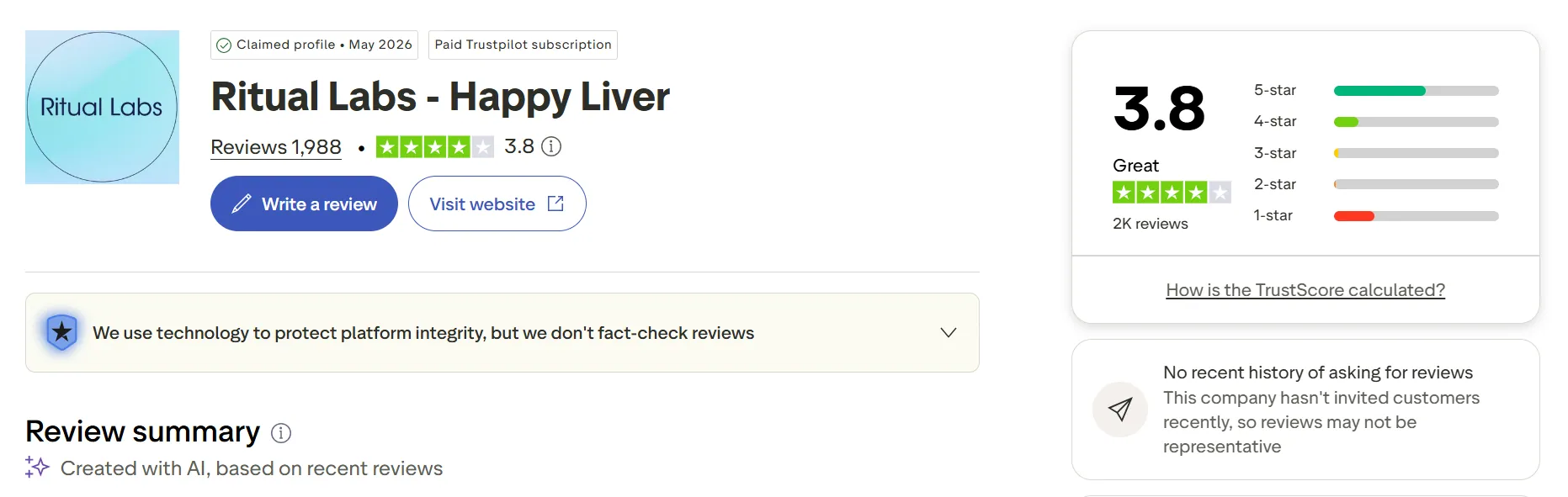
On Trustpilot, the rituallabs.shop profile has gathered around 1,830 reviews with a rating of 3.8 out of 5.
About 55% are five star reviews and around 26% are one star, with very little in between.
The profile was claimed in May 2026, runs on a paid subscription plan, and the company responds to most negative reviews, although typical response time reaches two weeks.
What stands out in the positive reviews
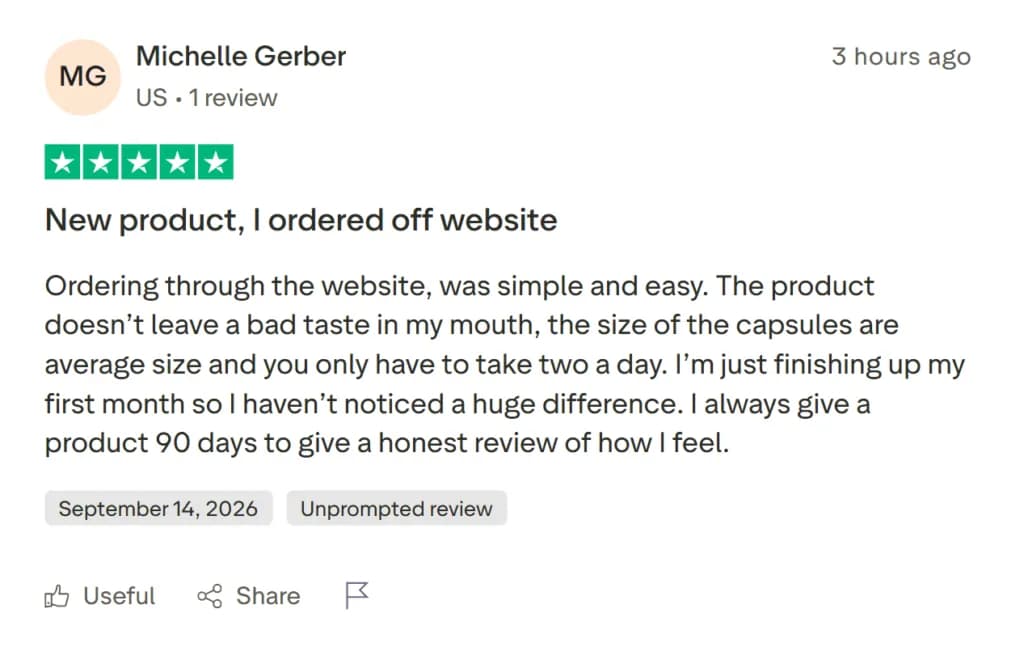
Three recurring themes show up among the high ratings.
The most frequent one is the speed of the support team once it finally responds, with specific mentions of individual agents.
The ease of the purchase process and the clarity of the product information on the page also come up. Some users claim to have noticed improvements in their liver panel results, although these are individual experiences without clinical verification.
What comes up repeatedly in the negative reviews
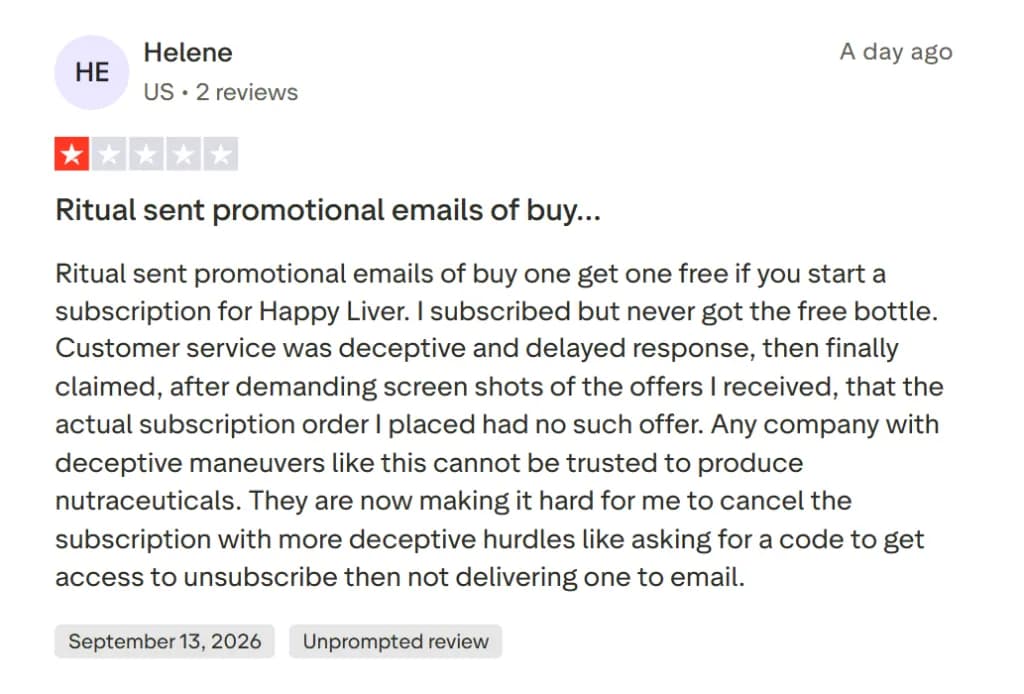
Almost all negative reviews revolve around:
- Unexpected charges.
- Failed cancellations.
- Returns that were never completed.
Wording also matters from a reputational standpoint.
Terms like “scam,” “fraud,” and “buyer beware” appear frequently in the titles of those reviews, and it is precisely the titles that Google indexes and displays.
Formal complaints on record
On the formal side, the BBB complaint file lists 30 complaints over the past three years, all closed within the last twelve months:
- 18 complaints are marked as resolved to the customer’s satisfaction.
- 10 were answered by the company without confirmation of closure from the customer.
- 2 went unanswered.
- The largest share involves product, delivery, and service issues.
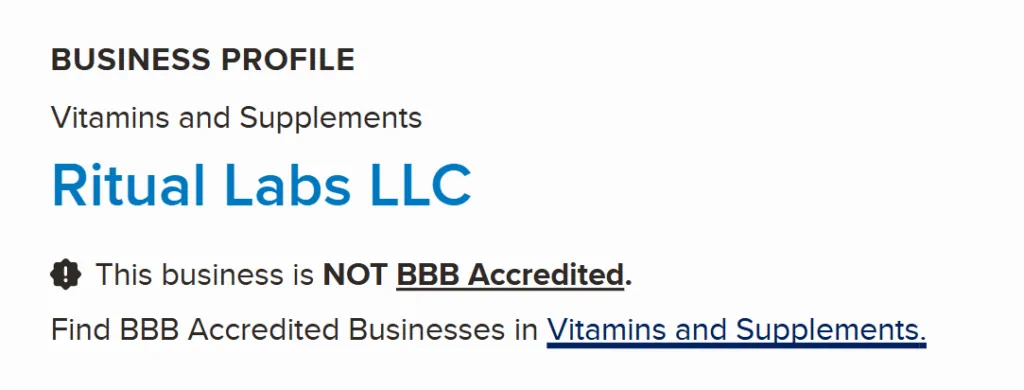
The BBB still lists the company as not accredited and without a rating assigned, indicating it is in the process of responding to previously closed complaints.
At the same time, the review section of that same profile averages one star out of five.
Reputational standing on Google, AI Overviews, and Reddit
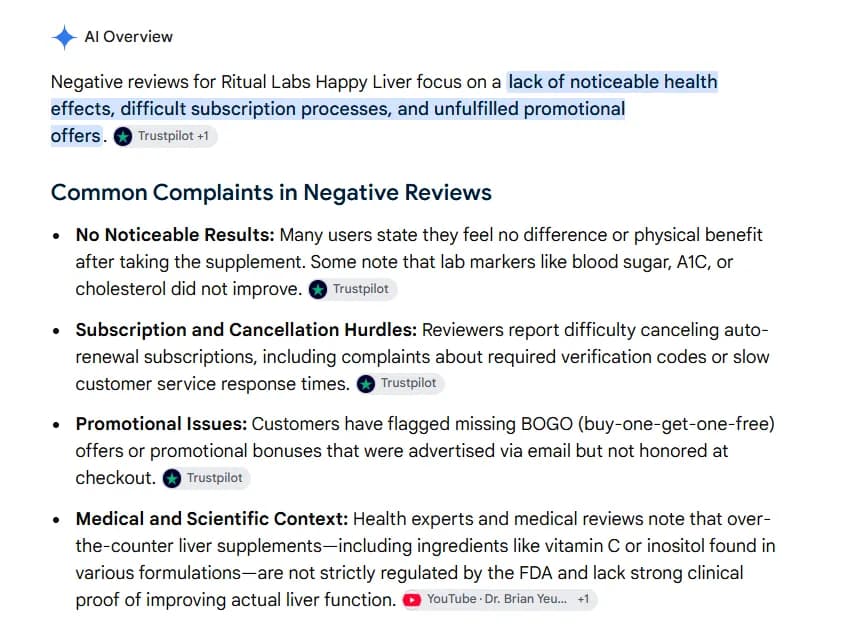
Searching for the product name brings up a first page that mixes the official site with third party articles framed around suspicion, including headlines in the style of “EXPOSED” or “subscription trap.”
AI Overviews and conversational assistants draw on authoritative sources such as the BBB, Trustpilot, and review outlets. When those sources agree on flagging subscription related issues, the generated summary tends to reflect that consensus.
There is also a brand identity problem. Confusion with Ritual, the well known vitamin brand, has led that other company to publicly clarify that certain complaints belong to a different business.
Which review profiles the brand has and which it could activate
The brand concentrates its verifiable presence on Trustpilot, in the BBB file, and on a Facebook page with just over 8,000 followers.
That footprint leaves important gaps that no one currently controls on its behalf:
- A Google Business profile, which is the first thing that shows up in a brand search.
- Marketplace presence with verified purchase reviews.
- Listings on review aggregators such as Sitejabber or ResellerRatings.
- Active social accounts with visible, traceable customer support.
- Original content that directly addresses billing and return concerns.
The difference between a brand with distributed presence and one that depends on just two platforms comes down, essentially, to how many results it controls when someone searches its name.
How a brand in this situation could fix its reputation

It is worth being clear about the order of operations here, since reversing it is the most common mistake. No online reputation strategy works if the root cause of the complaints is still active.
1. Fix the operational problems
Reasonable priorities for the business to address its current problems would include:
- Redesigning checkout so the subscription is accepted explicitly and separately.
- Enabling one step cancellation, without needing to email support.
- Honoring the 60 day guarantee within the stated timeframe and with valid return addresses.
- Opening an additional contact channel beyond email, with published response times.
- Auditing shipping and communicating realistic timelines instead of optimistic ones.
Each of these adjustments reduces the flow of negative reviews at the source.
It is the change that contributes most to a sustainable rating improvement, since it addresses the cause rather than the symptom.
2. Then, build an online presence
The usual next steps involve systematically requesting reviews from satisfied customers, responding to every negative review with a concrete and verifiable solution, and publishing original content that addresses real billing questions.
It is also worth claiming or consolidating duplicate profiles and activating the missing channels, so the first page of results stops being made up almost entirely of third party sources.
In cases involving defamatory posts, false content, or reviews that violate a platform’s policies, there is also the option of requesting their removal through the appropriate formal channels.
What this case teaches about brand reputation
Reading through the Happy Liver Ritual Labs reviews points to a conclusion that applies well beyond this one supplement: a brand can have a solid product and still build a reputation that is hard to sustain.
When more than a quarter of reviews point to the same issue, it is not a matter of difficult customers or unfair competition, but of an internal process generating frustration on a systematic basis.
The good news is that this kind of reputational damage tends to be reversible. Brands that fix their operations first and then work on their digital presence tend to recover their rating within months, not years.
If you are dealing with a similar situation, at Media Removal we help companies that need to get their online reputation in order, from removing defamatory content to rebuilding their search presence.
We can review your case and tell you honestly what can be fixed and what cannot.
 Subscribe to our newsletter